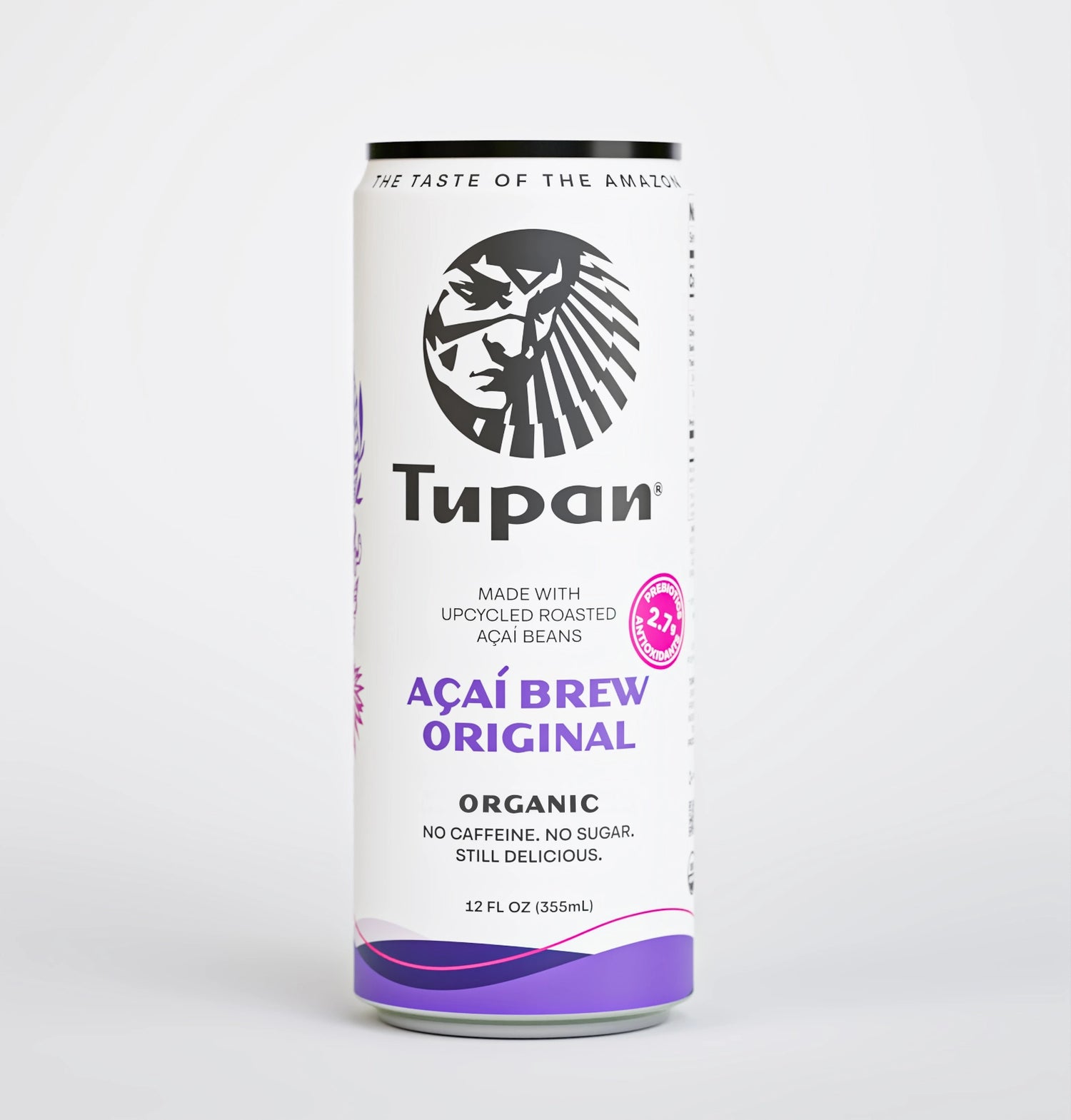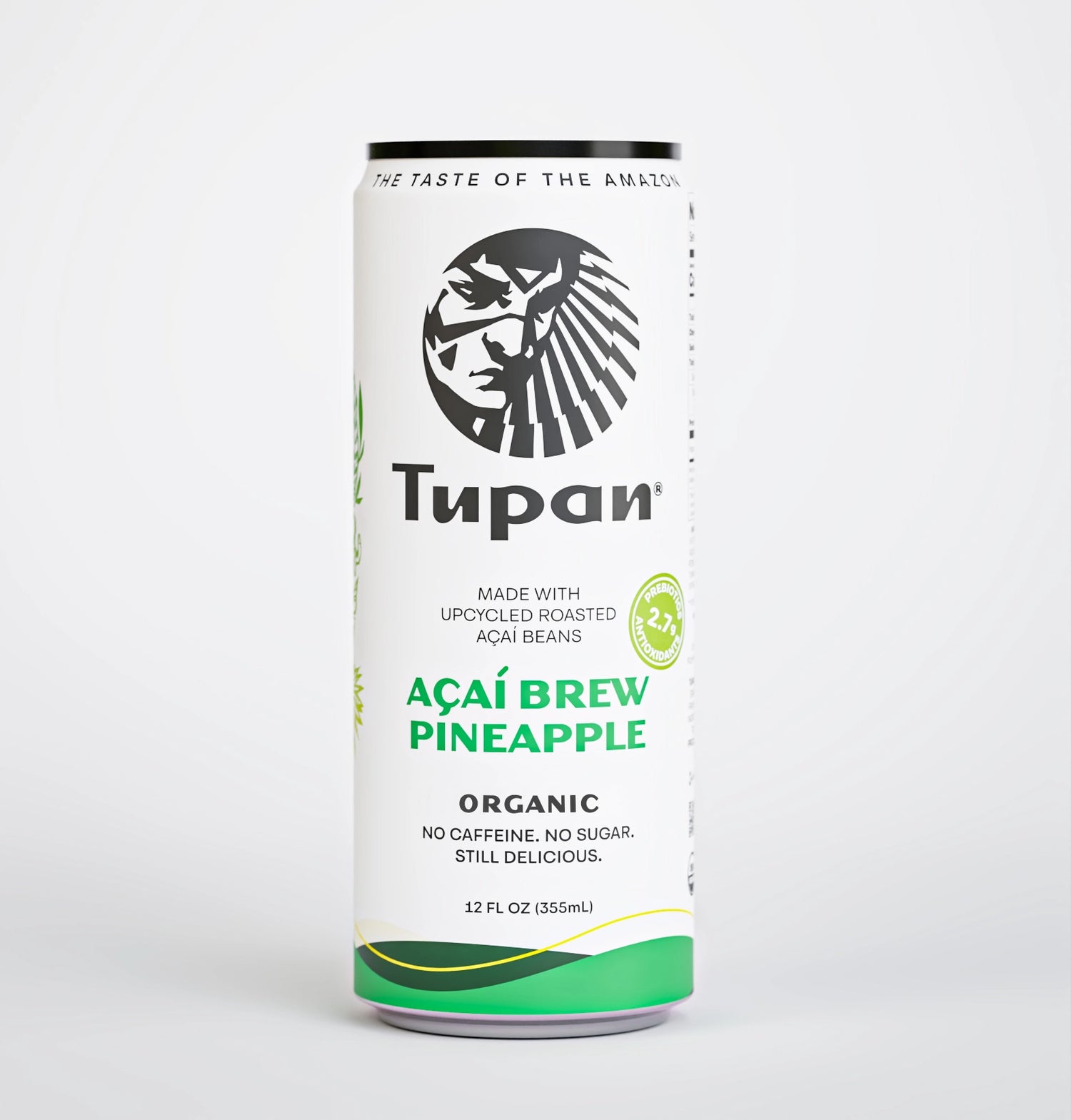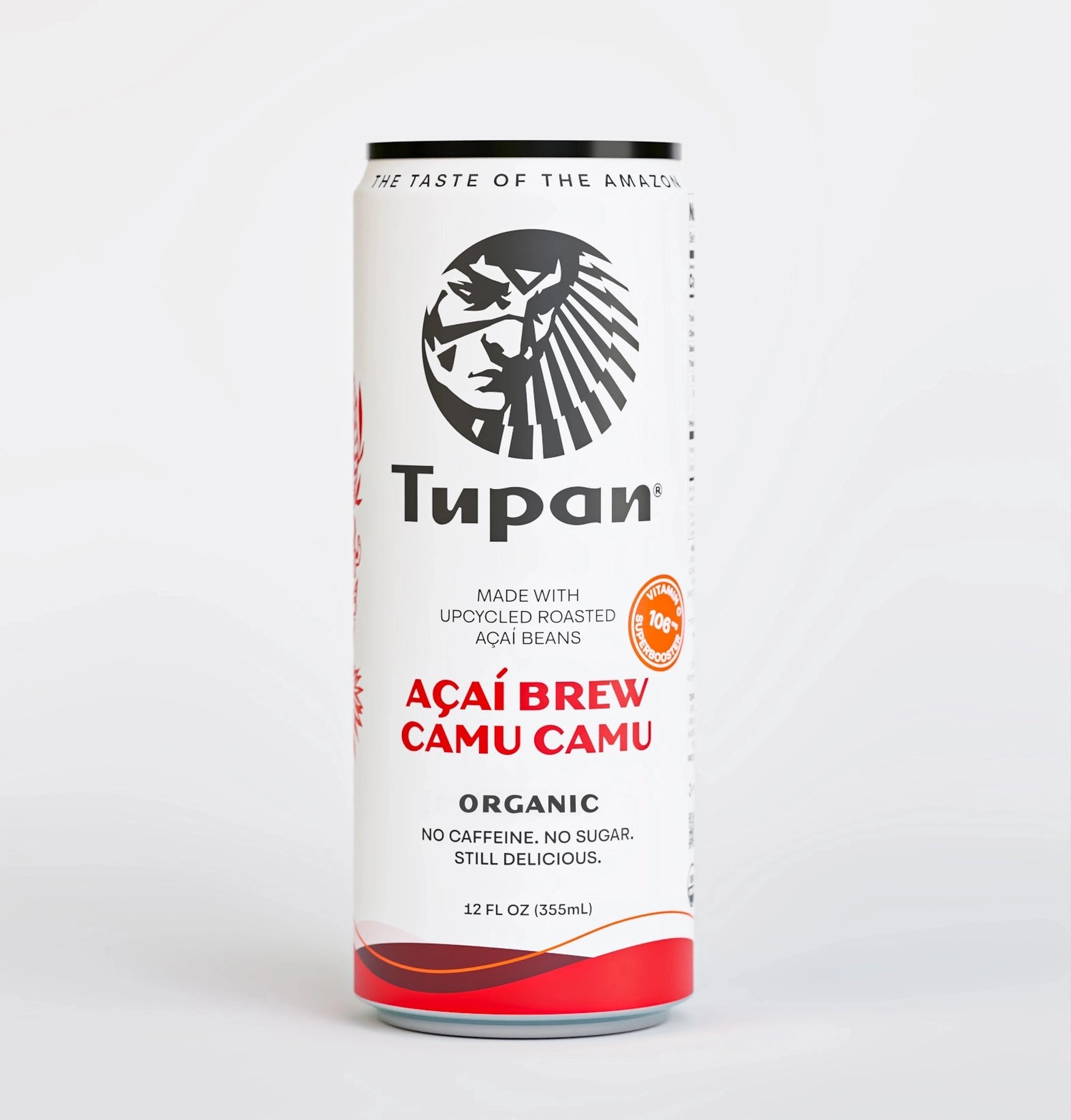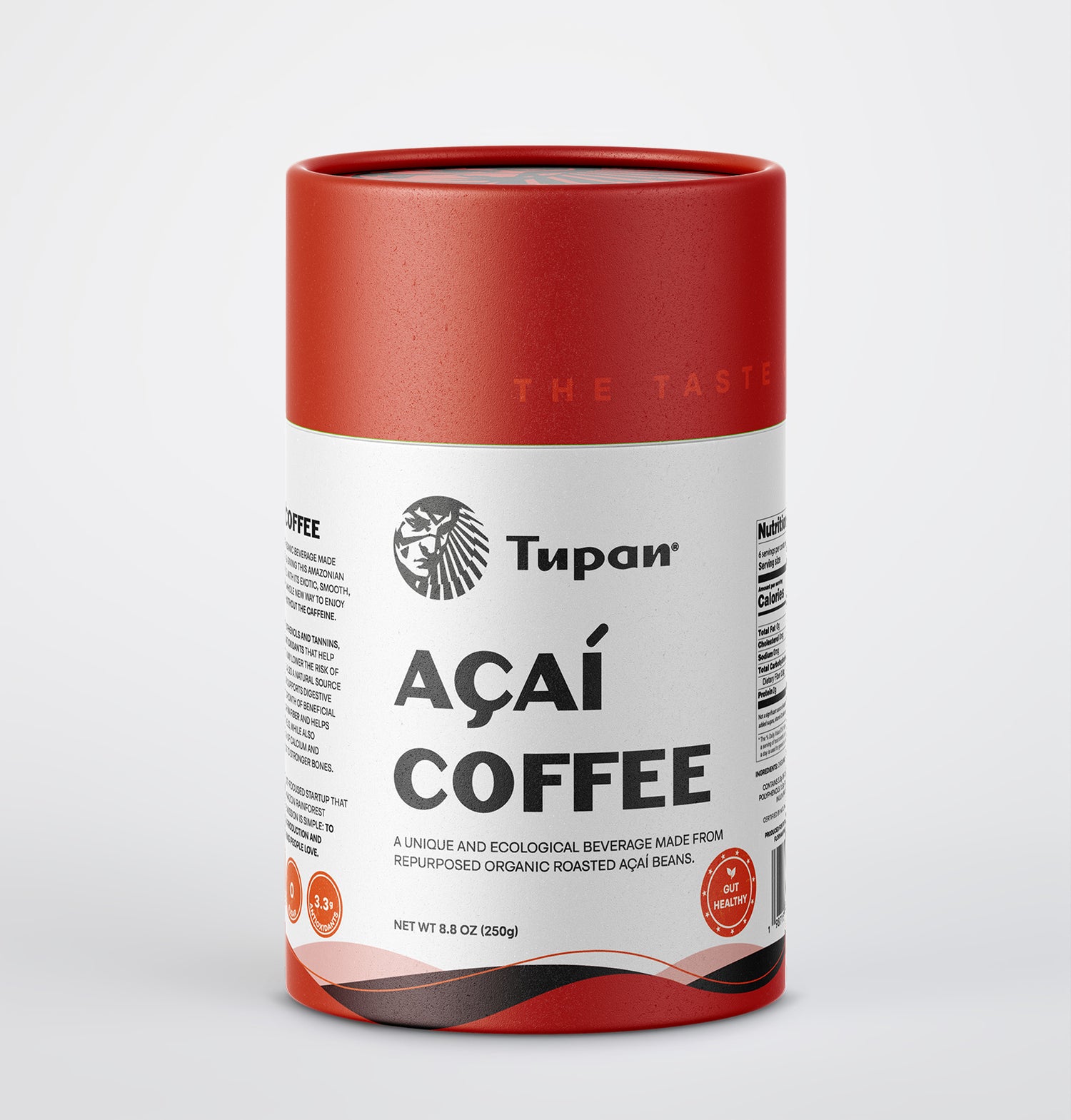
If you have never tried Açaí Coffee, the name creates an immediate question: what does it actually taste like?
The short answer is that well-produced Açaí Coffee can be smooth, roasted and layered, with sensory notes that may be described as toasted, nutty, earthy, woody, caramelized or cocoa-like. The exact experience depends on the açaí seeds, processing, roast profile, grind, brewing method and serving style.
But there is an equally important answer: Açaí Coffee does not need to taste exactly like conventional coffee to be good.
It is a different beverage made from a different plant. Traditional coffee comes from roasted seeds of Coffea species. Açaí Coffee is made from the roasted seeds of the açaí palm, Euterpe oleracea, the same Amazonian fruit globally known for its dark purple pulp.
New to Açaí Coffee? Explore our Ultimate Guide to Açaí Coffee for a complete look at what it is, how it is made, its origins, composition and how to brew it.
The familiar word “coffee” describes the roasted-beverage format and ritual. It does not mean that açaí seeds become coffee beans.
That distinction is the key to understanding the flavor.
AÇAÍ COFFEE DOES NOT TASTE LIKE AN AÇAÍ BOWL
For many first-time consumers, this is the biggest surprise.
The flavor most Americans associate with açaí usually comes from bowls, smoothies, frozen purées and other products in which açaí pulp may be combined with fruit, juice, guaraná, sweeteners or toppings.
Açaí Coffee begins with another part of the fruit: the seed.
The seed is cleaned, processed, roasted and ground before being brewed. Roasting changes its aroma and flavor, creating a sensory experience centered on roasted characteristics rather than the sweet, fruit-forward profile consumers may expect from an açaí bowl.
So if you approach a cup expecting something that tastes like berry juice, you are approaching the category from the wrong reference point.
Açaí Coffee belongs to the world of roasted beverages.
THE CORE FLAVOR PROFILE OF AÇAÍ COFFEE
There is no single flavor description that applies to every Açaí Coffee.
Seed origin, handling, moisture, roasting conditions, milling, freshness and preparation can all influence the final cup. That is especially important in an emerging category where producers may use different equipment and processes.
Still, several descriptors provide a useful vocabulary for understanding the experience.
TOASTED
Roasting is fundamental to Açaí Coffee. Heat transforms the seed and develops the aromatic character associated with a roasted beverage.
A toasted note is therefore one of the most intuitive ways to describe the category. It gives the cup warmth and familiarity without requiring it to imitate conventional coffee.
NUTTY
Depending on processing and roast development, the aroma and flavor may suggest roasted nuts. “Nutty” is a sensory comparison, not an indication that the product contains nuts.
This kind of note can contribute to the rounded character of a well-balanced cup.
EARTHY AND WOODY
Açaí Coffee can also present earthy or woody characteristics. In balance, these notes can reinforce the beverage’s deep, natural and roasted identity.
The important word is balance. A pleasant earthy dimension is different from a cup dominated by harshness or poorly controlled processing.
CARAMELIZED
Controlled heating can create deeper aromatic complexity and impressions that consumers may describe as caramelized.
That does not mean sugar or caramel has been added. A sensory descriptor identifies a perceived similarity in aroma or flavor; it is not necessarily an ingredient.
COCOA-LIKE
Some roasted profiles can evoke cocoa or dark-cacao associations.
Again, Açaí Coffee does not contain cocoa simply because a drinker perceives a cocoa-like note. The comparison gives consumers familiar language for describing an unfamiliar ingredient.
These descriptors should be treated as a sensory vocabulary, not as a rigid flavor specification. Açaí Coffee is a developing category, and different products can taste meaningfully different.
WHAT DOES TUPAN AÇAÍ COFFEE TASTE LIKE?
Tupan Açaí Coffee is designed around a smooth, roasted experience that lets the character of the açaí seed define the cup.
The goal is not to disguise the ingredient or force it to reproduce the exact flavor of arabica coffee. It is to create a distinctive roasted beverage that feels familiar enough to fit naturally into a coffee-style ritual while remaining unmistakably its own.
Tupan’s Açaí Coffee is made from roasted organic açaí seeds—often called açaí beans in consumer terminology—and contains no conventional coffee.
That matters because the sensory experience starts with the ingredient itself.
The result belongs to a new category: a roasted Amazonian beverage with depth and character, but without relying on coffee beans to create its identity.
For the broader story of the ingredient, production process, science, sustainability and category, explore Tupan’s Ultimate Guide to Açaí Coffee.
WHY ROASTING CHANGES THE FLAVOR

Raw açaí seeds and roasted açaí seeds are not sensorially equivalent.
Roasting changes moisture, physical structure and chemical composition. It also changes the volatile compounds associated with aroma.
This is not just a culinary observation. Recent research has begun examining how different roasting conditions affect the physicochemical, bioactive and volatile profiles of açaí seed powder.
A 2026 study published in the Journal of Food Biochemistry evaluated açaí seeds roasted under different time and temperature conditions and found that roasting substantially altered their volatile profile. The research reinforces a central idea for Açaí Coffee: roast development is part of flavor development.
Temperature and time therefore matter.
A lighter treatment and a more intense roast should not be expected to create identical cups. Producers can use roasting conditions to influence aroma intensity and the balance among toasted, caramelized, earthy, woody and other sensory characteristics.
This is one reason Açaí Coffee should not be treated as a generic commodity.
Two products can begin with the same species of açaí and still deliver very different experiences.
PROCESS IS PART OF TASTE
Flavor begins before the seed reaches the roaster.
Raw-material origin and condition matter. Cleaning matters. Drying and moisture control matter. Storage matters. Roasting consistency matters. Milling matters.
Then brewing adds another layer of variables.
This means “What does Açaí Coffee taste like?” has no responsible answer that ignores processing.
Think about other roasted ingredients. Cacao can become radically different products depending on fermentation, roasting and formulation. Coffee itself can taste dramatically different depending on origin, processing, roast and extraction.
Açaí Coffee follows the same broader principle: transformation determines experience.
This is why specialized processing becomes especially important for a new beverage category. A producer is not simply making a seed darker. The producer is developing a repeatable sensory profile.
DOES AÇAÍ COFFEE TASTE LIKE REGULAR COFFEE?
Not exactly—and that is not a flaw.
Açaí Coffee and conventional coffee can share sensory territory because both are roasted and brewed. Consumers may recognize familiar dimensions such as roasted aromas, bitterness, depth, warmth and the ritual of preparing a hot cup.
But the raw materials are fundamentally different.
Coffee beans come from Coffea plants. Açaí Coffee comes from Euterpe oleracea seeds.
Different plant chemistry means a different foundation for flavor.
Açaí Coffee should therefore be understood as a coffee alternative rather than a replica of coffee.
The comparison is useful for explaining how the beverage fits into daily life. It becomes less useful when it creates the expectation that every sip must reproduce arabica or robusta.
A new category becomes more interesting when consumers learn to recognize what makes it distinctive.
IS AÇAÍ COFFEE BITTER?
Bitterness can be part of a roasted beverage, but its intensity is not fixed.
The perceived bitterness of Açaí Coffee can be influenced by roast development, concentration, extraction time, water temperature, grind size and serving method.
A darker or more aggressively extracted preparation may not taste the same as a more balanced brew.
Astringency can also be confused with bitterness. They are different sensations: bitterness is a taste, while astringency is the drying or puckering sensation experienced in the mouth.
Because açaí seeds contain tannins and other phenolic compounds, this distinction is useful when learning the sensory language of the beverage.
The objective of a well-prepared cup is not necessarily to eliminate every intense sensation. It is to create balance among aroma, flavor, body and finish.
IS AÇAÍ COFFEE SWEET?
Pure Açaí Coffee should not be expected to taste like a sweetened açaí bowl.
When people use words such as “caramelized” to describe roasted ingredients, they are often talking about sensory impressions rather than added sugar.
Sweetness perception can also change with brewing, temperature and additions such as dairy or plant-based milk.
The finished formulation matters as well. A commercial product could contain other ingredients, so consumers should always read the ingredient list and nutrition information rather than assuming that every product marketed as Açaí Coffee has the same composition.
Tupan Açaí Coffee is built around the roasted açaí seed itself, allowing consumers to experience the ingredient directly.
WHAT DOES AÇAÍ COFFEE SMELL LIKE?
Aroma is a major part of flavor.
Before the first sip, volatile compounds reaching the nose begin shaping what the brain expects from the beverage.
Roasting can develop a warmer and deeper aromatic profile in açaí seeds. Depending on the product and roast, people may associate the aroma with toasted ingredients, nuts, earth, wood, caramelization or cocoa.
Scientific work is beginning to make this part of the category more measurable.
The 2026 Journal of Food Biochemistry study on roasted açaí seed powder specifically analyzed volatile compounds under different roasting conditions. That research is important because volatile compounds are central to aroma development and can help connect processing decisions with the sensory characteristics consumers eventually perceive.
As research expands, the vocabulary of Açaí Coffee may become more precise.
Today, the best approach is to combine scientific understanding with sensory evaluation rather than pretend that one universal aroma profile already exists.
HOW BREWING CHANGES THE CUP
Roasting creates the potential flavor. Brewing determines how much of that potential reaches the cup.
When hot water interacts with ground roasted açaí seeds, compounds move from the solid material into the beverage. The result can change according to water temperature, Açaí Coffee-to-water ratio, particle size, extraction time, filtration, agitation, brewing equipment, water composition and serving temperature.
This explains why two people can prepare the same package and experience different intensity, body and balance.
It also explains why preparation instructions matter.
Açaí Coffee may borrow familiar rituals from coffee, but it is not made from coffee beans. The ideal extraction parameters should therefore be developed for the actual ingredient rather than assumed to be identical to conventional coffee.
For Tupan Açaí Coffee, following the preparation guidance on the product page is the best starting point for experiencing the cup as intended.
HOT VS. ICED AÇAÍ COFFEE
Serving temperature changes perception.
A hot cup tends to make aromatic compounds more immediately noticeable and emphasizes the comforting ritual associated with freshly brewed beverages.
An iced preparation can feel lighter and more refreshing, while cooling can change how aroma, bitterness and overall intensity are perceived.
Neither format defines the category.
That flexibility is useful because Açaí Coffee does not have to occupy only the traditional morning-coffee occasion. A caffeine-free roasted beverage can move between hot and cold formats and different moments of the day.
The same ingredient can therefore create very different sensory experiences without losing its identity.
WHAT HAPPENS WHEN YOU ADD MILK?
Milk or plant-based alternatives can soften and reshape the sensory experience.
They can change texture, perceived sweetness, aroma intensity and overall balance. A more pronounced roasted or astringent sensation may also be perceived differently once the beverage is combined with milk.
Consumers who enjoy a stronger expression of the roasted seed may prefer Açaí Coffee black. Others may prefer it with dairy milk, oat, almond, coconut or another plant-based option.
There is no need for a new category to impose a single ritual.
Experimentation is part of discovering it.
WHY ONE AÇAÍ COFFEE MAY TASTE VERY DIFFERENT FROM ANOTHER
This may be one of the most important things to understand about Açaí Coffee today.
The category is young.
There is no universal roast standard, grind standard, sensory grading system or preparation protocol shared by every producer. Different companies can source different raw material, use different processing methods, roast with different equipment and target different sensory profiles.
As a result, tasting one Açaí Coffee does not necessarily tell you what all Açaí Coffee tastes like.
A poorly controlled roast can create a very different impression from a carefully developed one.
In established categories, consumers already understand this principle. Nobody assumes that disliking one coffee means disliking every coffee grown in the world. People recognize differences among origins, roasters, roast levels and brewing methods.
Açaí Coffee deserves the same distinction.
As the category develops, consistency and sensory standards will become increasingly important because first experiences can shape consumer expectations.
A new category has to earn the second cup.
WHAT SHOULD A GOOD AÇAÍ COFFEE TASTE LIKE?
There is not yet a universal sensory standard that allows anyone to declare one exact profile as the definition of quality.
But a useful quality framework can still be established.
A well-produced cup should feel intentional.
The aroma should reflect controlled roasting rather than obvious processing defects. Flavor characteristics should work together rather than compete chaotically. Intensity should make sense for the preparation. The finish should support the overall experience. And, critically, one package should offer a reasonably consistent experience compared with the next.
Quality is not simply darkness.
It is not maximum bitterness.
It is not maximum roast.
And it is not the ability to imitate conventional coffee perfectly.
Quality is control, balance, repeatability and a sensory identity worth returning to.
A NEW FLAVOR NEEDS ITS OWN VOCABULARY
Every unfamiliar food begins with comparisons.
People describe a new ingredient using things they already know: nutty, chocolate-like, tea-like, fruity, earthy, smoky, creamy.
Those comparisons are useful bridges.
Eventually, successful categories develop their own expectations.
Specialty coffee has a sophisticated sensory vocabulary. Wine has one. Chocolate has one. Tea has one.
Açaí Coffee is at a much earlier stage.
That creates an unusual opportunity.
Consumers, producers, food scientists and beverage developers are not simply discovering a product. They are helping define how an emerging roasted beverage category will be understood.
Terms such as toasted, nutty, earthy, woody, caramelized and cocoa-like are useful today because they translate the experience into familiar references.
Over time, better sensory research, more standardized production and broader consumer experience may create a more specific language.
That evolution is part of category building.
THE FLAVOR OF AÇAÍ COFFEE STARTS IN THE AMAZON
The sensory story cannot be completely separated from the ingredient story.
Açaí palms are deeply connected to the Amazon region, while the global açaí industry has historically concentrated commercial attention on the pulp.
Yet the seed represents most of the fruit’s physical mass and has often been treated as a residual material after pulp processing.
Transforming that seed into a roasted beverage changes its destination.
Instead of seeing the seed only as something left behind, Açaí Coffee treats it as a food ingredient capable of carrying its own economic and sensory value.
This is where flavor and circularity meet.
Upcycling only becomes commercially meaningful when the transformed material becomes something people genuinely want.
A beverage cannot build a category on sustainability alone.
People have to want another cup.
That makes flavor more than a marketing detail. It is part of the economic logic that can turn an overlooked material into a valued ingredient.
AÇAÍ COFFEE IS NOT TRYING TO REPLACE EVERY CUP OF COFFEE
The easiest way to misunderstand Açaí Coffee is to force it into an unnecessary competition with conventional coffee.
Coffee has centuries of agricultural, cultural and sensory history. It does not need to disappear for Açaí Coffee to matter.
Açaí Coffee creates another choice.
Someone may drink traditional coffee in the morning and choose Açaí Coffee later.
Someone who avoids caffeine may be interested in the ritual of a roasted beverage without conventional coffee.
Someone else may simply be curious about Amazonian ingredients and new flavors.
These occasions can coexist.
From a sensory perspective, that is liberating. Açaí Coffee does not have to become a perfect imitation of something else.
It can become recognizable for what it is.
SO, WHAT DOES AÇAÍ COFFEE ACTUALLY TASTE LIKE?
Expect a roasted beverage, not a liquid açaí bowl.
Depending on the product, roast and preparation, the cup may present toasted, nutty, earthy, woody, caramelized or cocoa-like characteristics, with the exact balance changing according to processing and brewing.
Expect familiarity, because roasting and brewing create sensory cues and rituals that coffee drinkers already understand.
But expect difference too.
Açaí Coffee comes from another plant, another seed and another food tradition. Its value is not that it secretly tastes identical to arabica.
Its value is that an overlooked Amazonian seed can become a distinctive beverage with an identity of its own.
The best way to understand that identity is ultimately simple:
Taste the cup on its own terms.
For a deeper look at what Açaí Coffee is, how açaí seeds are processed and roasted, the science behind the ingredient, its connection to the circular economy, brewing, caffeine, certifications and the emerging category itself, read The Ultimate Guide to Açaí Coffee by Tupan.
Want to go beyond flavor? Read our Ultimate Guide to Açaí Coffee to explore the complete story behind this Amazonian coffee alternative, from the açaí seed to the finished cup.
SOURCE
Pereira, G. S. L., et al. “Roasting-Induced Changes in Bioactive Compounds and Volatile Profile of Açaí (Euterpe oleracea) Seeds Powder Assessed by Response Surface Methodology and Principal Components Analysis.” Journal of Food Biochemistry, 2026. DOI: 10.1155/jfbc/6623391.
da Silva, L. R., et al. “Upcycled Beverage From Roasted Açaí (Euterpe oleracea) Seeds: Antioxidant Capacity and Cytoprotection Through Gastrointestinal Simulation.” Molecular Nutrition & Food Research, 2025. DOI: 10.1002/mnfr.70270.
Negrão, C. M., et al. “Estudo Físico-Químico de Café de Açaí.” Congresso Brasileiro de Química, 2022.