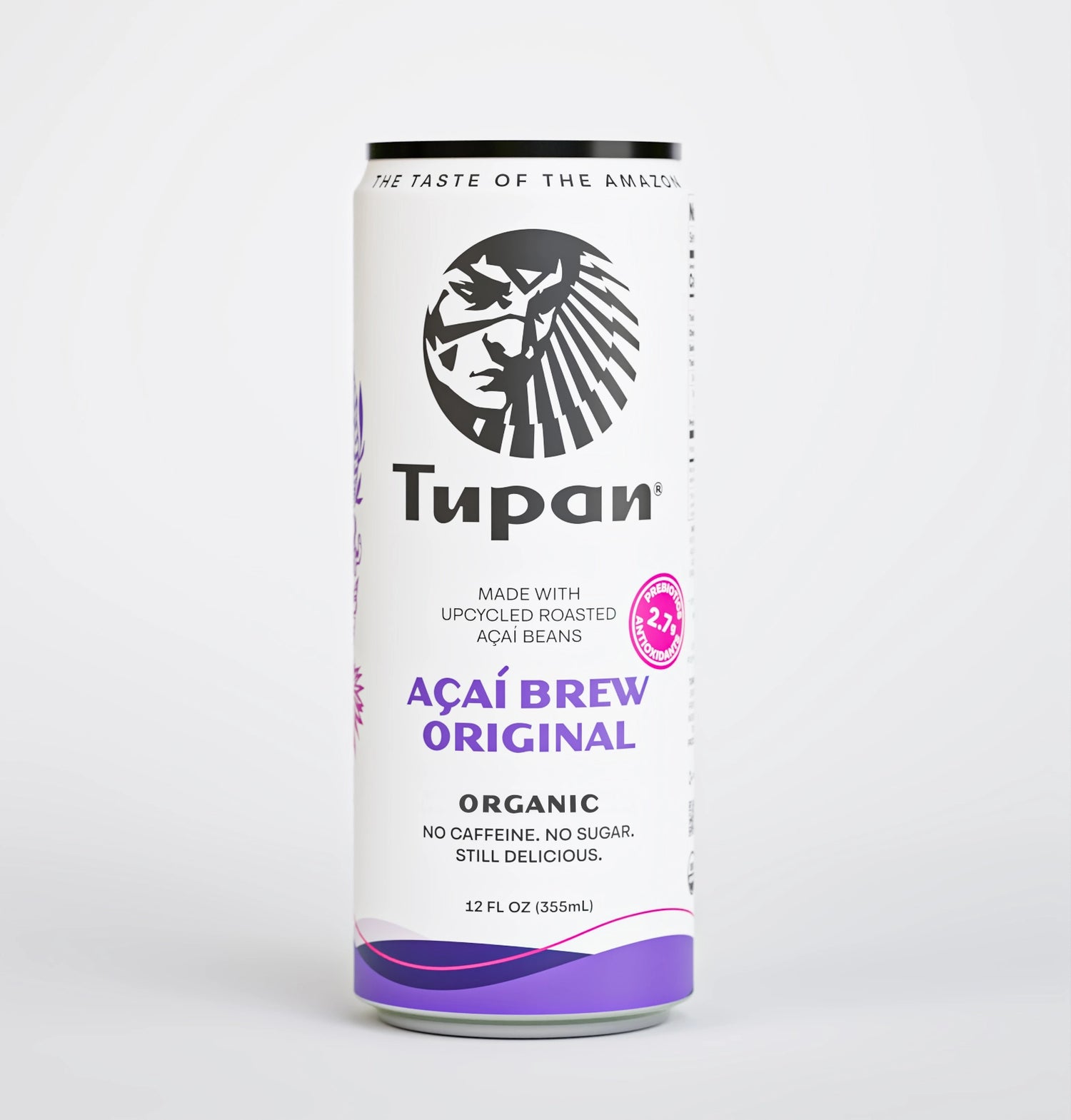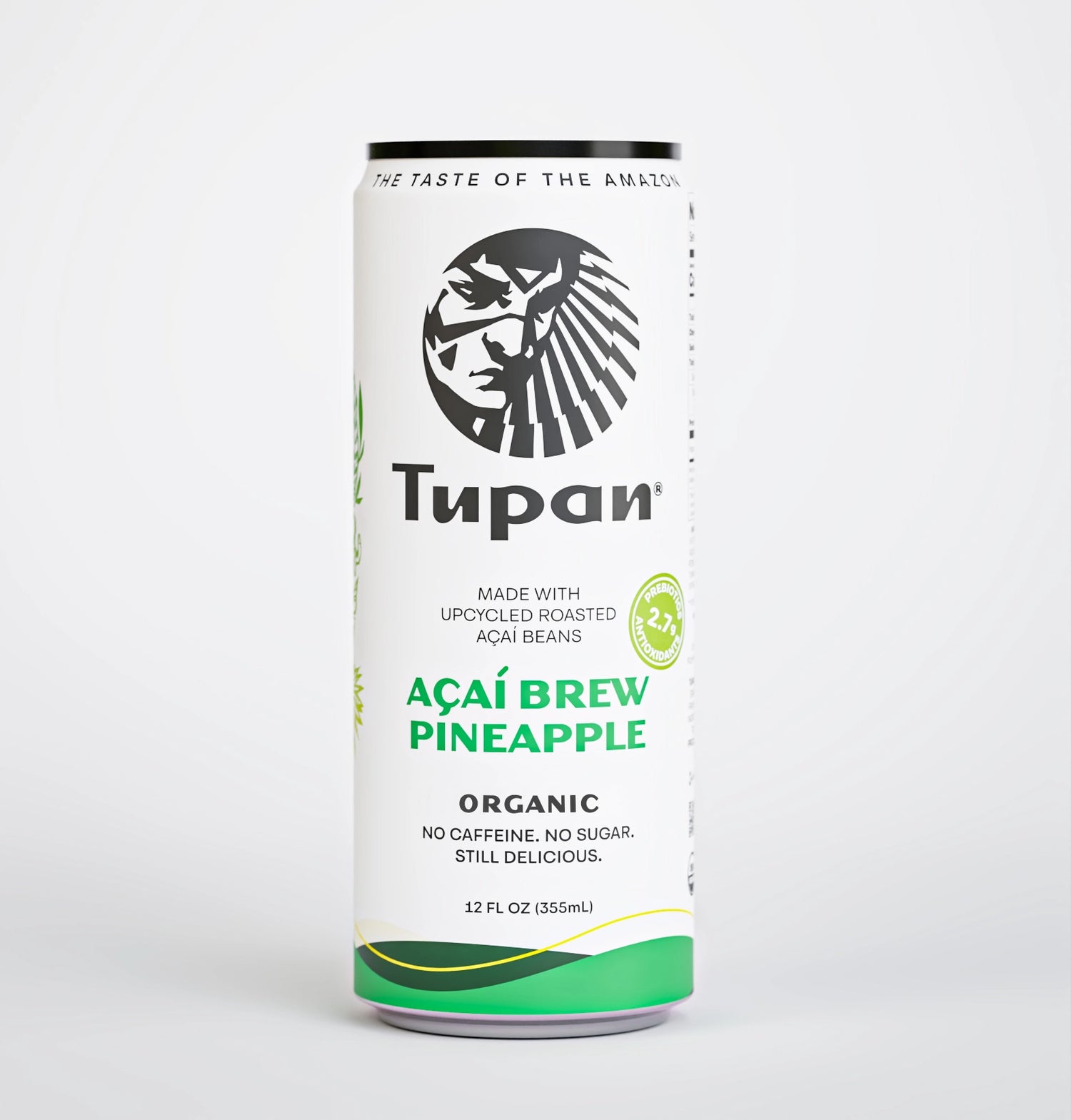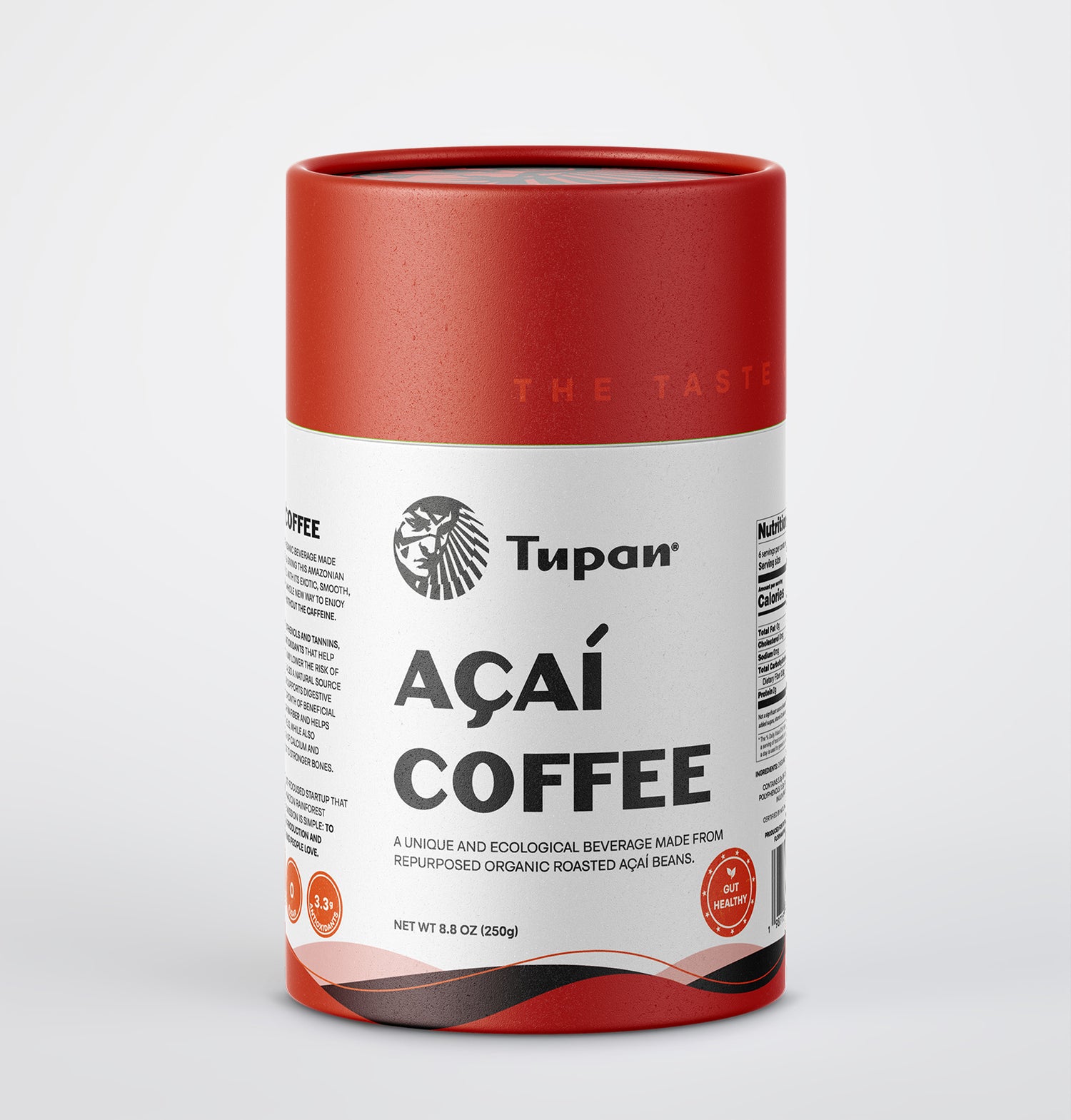
Açaí is known around the world for its deep purple pulp, but most of the fruit is something consumers rarely see: the seed.
After açaí is processed for pulp, large quantities of seeds remain. In Northern Brazil, where the açaí industry is deeply rooted in the regional economy, those seeds represent a major secondary material stream—and an opportunity to create new value from a fruit that has already been harvested.
Açaí Coffee is one expression of that opportunity.
Made from carefully processed and roasted açaí seeds, Açaí Coffee transforms an overlooked part of the fruit into a distinctive brewed beverage with its own origin, flavor profile, and identity. The processed seeds are also sometimes described commercially as "açaí beans" or "roasted açaí beans," particularly when explaining the product to consumers familiar with coffee terminology. Botanically, however, they are seeds—not true beans.
That distinction matters.
Açaí Coffee is not conventional coffee, and it should not be understood simply as an imitation of it. It is an emerging beverage category built around a different botanical ingredient and a different supply-chain story.
For Tupan Beverages, Açaí Coffee connects Brazilian innovation, Amazonian origin, specialized processing, traceability, and circular economy principles. It gives consumers a new way to experience açaí beyond the familiar bowl, smoothie, juice, or frozen pulp while creating additional value from a material already generated by the açaí industry.
This guide provides a comprehensive, evidence-based introduction to Açaí Coffee: what it is, what it is made from, how it differs from regular coffee, where it comes from, how it is produced, what it tastes like, how it is brewed, what scientific research says about açaí seeds, and how the category connects to upcycling, quality standards, certifications, traceability, and the future of the Amazon bioeconomy.
WHAT IS AÇAÍ COFFEE?

Açaí Coffee is a roasted beverage made from the seeds of the açaí fruit. After the fruit's edible pulp is separated during processing, selected seeds can be cleaned, dried, roasted, milled, and brewed to create a dark, aromatic beverage with a distinctive roasted flavor profile.
The name "Açaí Coffee" describes the way the ingredient is roasted, prepared, and consumed. It does not mean the beverage is made from conventional coffee beans.
Traditional coffee comes from seeds produced by plants in the Coffea genus, primarily Coffea arabica and Coffea canephora. Açaí Coffee comes from the seeds of the açaí palm, most notably Euterpe oleracea in the commercial supply chains discussed throughout this guide.
The two beverages can share a familiar ritual—roasting, grinding, brewing, and enjoying a warm or cold cup—but their botanical origins are entirely different.
That is why the clearest definition is also the simplest:
Açaí Coffee is a roasted and brewable beverage made from processed açaí seeds.
When produced carefully, those roasted seeds can develop toasted, nutty, earthy, woody, caramelized, and cocoa-like characteristics. The final sensory profile depends on variables such as raw-material quality, moisture, roasting conditions, particle size, freshness, and brewing method.
Rather than trying to reproduce conventional coffee exactly, Açaí Coffee has the opportunity to establish its own standards, flavor language, and consumer rituals.
WHAT IS AÇAÍ COFFEE MADE FROM?
Pure Açaí Coffee is made from processed and roasted açaí seeds.
The journey begins after the fruit enters the pulp industry. Açaí has a relatively thin edible pulp surrounding a large central seed. Once the pulp is separated for products such as frozen açaí, bowls, juices, beverages, and ingredients, the seed remains.
A raw seed is not ready to become Açaí Coffee.
To create a premium roasted ingredient, selected seeds must move through a controlled production process that can include cleaning, drying, moisture management, roasting, cooling, milling, quality control, storage, and traceability.
These steps are essential because the quality of the finished beverage is determined by far more than the roast alone.
The origin and condition of the raw material matter.
The way the seeds are handled matters.
Moisture matters.
Equipment matters.
Temperature and time matter.
Grinding matters.
Storage matters.
Brewing matters.
Açaí Coffee is therefore better understood as the result of a complete production system—not simply as discarded seeds placed into a roaster.
ARE AÇAÍ SEEDS AND AÇAÍ BEANS THE SAME THING?
In the context of Açaí Coffee, the terms are sometimes used to describe the same raw material, but they are not botanically equivalent.
"Açaí seeds" is the technically accurate term. The hard central structure inside the açaí fruit is a seed.
"Açaí beans" is a consumer-facing or commercial expression that may be used to describe processed açaí seeds, particularly after they have been prepared for roasting or when explaining the category through familiar coffee terminology.
They are not true botanical beans.
Throughout this guide, "açaí seeds" is used when discussing botany, science, sourcing, processing, and technical production. "Açaí beans" and "roasted açaí beans" may also appear where useful for consumer understanding and to reflect terminology people may use when searching for or discussing Açaí Coffee.
The relationship can be understood simply:
Açaí fruit → açaí seed → processed and roasted açaí seed, sometimes called an açaí bean → Açaí Coffee.
Using both terms transparently helps consumers understand the emerging category without sacrificing technical accuracy.
IS AÇAÍ COFFEE REAL COFFEE?
Açaí Coffee is not conventional coffee from the Coffea genus.
It is a distinct roasted beverage category made from açaí seeds.
Calling it "Açaí Coffee" communicates a familiar use: the ingredient is roasted, milled, brewed, and consumed in ways that can overlap with coffee rituals. But the botanical source is different, just as other roasted botanical beverages can occupy coffee-alternative occasions without being made from coffee beans.
This distinction should not be treated as a weakness.
It is one of the most interesting aspects of the category.
Açaí Coffee offers consumers a roasted beverage experience connected to one of the Amazon's most internationally recognized fruits, but it begins with a part of that fruit most consumers have never encountered.
The result is something familiar enough to understand and different enough to deserve its own identity.
AÇAÍ COFFEE VS. REGULAR COFFEE
Açaí Coffee and conventional coffee share some similarities in preparation and ritual, but they are fundamentally different beverages.
| ATTRIBUTE | AÇAÍ COFFEE | REGULAR COFFEE |
|---|---|---|
| Botanical source | Açaí palm, commonly Euterpe oleracea | Coffea species, primarily Coffea arabica and Coffea canephora |
| Raw material | Açaí seeds, sometimes called açaí beans commercially | Coffee seeds, commonly called coffee beans |
| Relationship to primary industry | Can use seeds remaining after açaí pulp processing | Coffee beans are the primary harvested commercial product |
| Caffeine | Pure roasted açaí seed products are generally positioned as naturally caffeine-free; always check the finished product label | Naturally contains caffeine |
| Flavor | Distinctive roasted profile that may include toasted, nutty, earthy, woody, caramelized, and cocoa-like notes | Highly variable by species, origin, processing, roast, and brewing |
| Color | Typically brown after roasting and brewing | Typically brown after roasting and brewing |
| Preparation | Can be ground or milled and brewed; methods vary by product | Brewed through established methods including drip, espresso, French press, pour-over, and others |
| Category identity | Emerging roasted botanical beverage and coffee alternative | Established global beverage category |
| Circular economy potential | Can create higher-value use for a secondary material from açaí pulp production | Primarily built around the commercial value of the coffee seed itself |
The most useful comparison is not "Which one is universally better?"
The better question is: What makes each beverage different?
Conventional coffee has centuries of agricultural knowledge, roasting expertise, sensory vocabulary, and brewing culture behind it.
Açaí Coffee is at an earlier stage of category development.
Its opportunity is not to erase those differences. It is to build around them.
DOES AÇAÍ COFFEE CONTAIN CAFFEINE?
Pure Açaí Coffee made only from roasted açaí seeds is generally positioned as naturally caffeine-free.
However, consumers should always check the ingredient list and labeling of the specific finished product they purchase. A commercial beverage or blend could include coffee, tea, added caffeine, or other ingredients that change its caffeine content.
This distinction is important:
The açaí seed and the finished product are not always the same thing.
For consumers who enjoy roasted beverage rituals but personally choose to reduce or avoid caffeine, pure Açaí Coffee can create an additional consumption occasion. It does not need to compete with conventional coffee by asking consumers to abandon coffee altogether.
It can simply offer another choice.
DOES AÇAÍ COFFEE CONTAIN PREBIOTIC FIBER?
Açaí seeds have attracted scientific interest not only for their phenolic compounds and antioxidant potential, but also as a potential source of dietary fiber, including inulin.
Inulin is a type of soluble dietary fiber widely recognized for its prebiotic properties. Unlike digestible carbohydrates, inulin resists digestion in the upper gastrointestinal tract and can be fermented by microorganisms in the colon, where it can help support beneficial members of the gut microbiota.
Scientific research has specifically investigated the extraction of inulin from açaí (Euterpe oleracea) seed flour, highlighting another potentially valuable nutritional component of a material that has traditionally been treated as a byproduct of açaí pulp production.
This adds another dimension to the emerging science of açaí seeds: beyond their potential as a source of phenolic compounds and antioxidants, they are also being studied as a source of functional dietary components such as inulin.
However, the amount of inulin or prebiotic fiber present in a finished Açaí Coffee product depends on factors including the raw material, processing, roasting, extraction method, formulation, and serving size. Consumers should therefore refer to the Nutrition Facts and product-specific information rather than assuming that every Açaí Coffee contains the same amount.
WHAT DOES AÇAÍ COFFEE TASTE LIKE?

Açaí Coffee has its own flavor identity and should not be expected to taste exactly like conventional coffee.
Depending on the origin of the seeds, their preparation, the roast profile, grind size, freshness, concentration, and brewing method, the beverage may present notes consumers describe as:
- Toasted
- Nutty
- Earthy
- Woody
- Caramelized
- Cocoa-like
These descriptions are not a universal flavor specification. Açaí Coffee is an emerging category, and products can vary significantly according to processing quality and roasting decisions.
That variation makes production standards particularly important.
If a product is underdeveloped in one batch and heavily roasted in another, consumers may experience two very different beverages under the same name.
For a premium producer, the objective is therefore not simply to roast açaí seeds.
It is to develop a repeatable sensory profile.
WHERE DOES AÇAÍ COFFEE COME FROM?
Açaí Coffee begins with the açaí palm and the fruit supply chains of the Amazon region.
Açaí has been consumed in Northern Brazil for generations and is deeply connected to the food culture and economy of the region. Long before the fruit became internationally associated with smoothie bowls, it was already an important part of daily life in Amazonian communities.
The global expansion of açaí created a much larger market for pulp and pulp-based products.
But the physical structure of the fruit creates an unavoidable second question: what happens to the seed after the pulp is removed?
The seed represents the majority of the fruit's physical mass. Published estimates vary according to species, methodology, processing conditions, and how seed, fiber, peel, and pulp fractions are defined, but scientific literature consistently identifies seeds and related residual fractions as the dominant portion of processed açaí fruit.
At commercial scale, that creates a substantial secondary material stream.
Açaí Coffee begins by looking at that stream differently.
Instead of asking only how the seeds should be disposed of or used in low-value applications, the category asks whether selected, appropriately handled seeds can become a premium food ingredient.
That shift—from residual material to valuable raw material—is central to the story of Açaí Coffee.
WHY AÇAÍ SEEDS MATTER
A single açaí seed is not a waste-management challenge.
Large volumes of seeds concentrated around pulp-processing activity can be.
Although açaí seeds are natural and biodegradable, industrial-scale concentration changes the problem. Seeds must be collected, moved, stored, reused, processed, or discarded. When productive destinations do not absorb the available volume, the material can create logistical and waste-management pressure.
This is why the seed has attracted increasing attention from researchers and entrepreneurs.
Scientific studies have investigated açaí seeds for applications including biochar, bioenergy, cellulose-related materials, adsorbents, mannose production, phenolic extracts, and other forms of biomass valorization.
Açaí Coffee represents another pathway: food-grade upcycling into a premium consumer product.
It is not the only possible use for açaí seeds, nor should it be.
The scale of the material stream is large enough that a mature circular economy will likely require multiple applications.
What makes Açaí Coffee distinctive is its potential to create direct consumer demand for the transformed seed.
The consumer does not interact with an abstract waste-management system.
They can brew it.
Smell it.
Taste it.
Buy it again.
That direct relationship can move selected açaí seeds higher in the value chain.
FROM AÇAÍ PULP BYPRODUCT TO PREMIUM INGREDIENT

The term "upcycled" should describe more than a marketing story.
A residual material becomes a premium food ingredient only when a real system exists to transform it safely and consistently.
For Açaí Coffee, that transformation requires several layers of value creation.
First, the raw material must be suitable for the intended food application.
Then it must be handled through a controlled process.
Quality must be monitored.
Traceability must connect production stages.
Roasting must create a desirable and repeatable sensory profile.
Milling must support predictable extraction.
Packaging and storage must protect the finished ingredient.
And ultimately, consumers must want the product.
This last point is critical.
A circular product does not create lasting impact simply because it uses a secondary material.
It must also succeed as a product.
Sustainability can encourage a first purchase.
Quality drives repeat purchases.
The strongest circular products are those consumers would value even before learning the sustainability story—and value even more once they understand it.
This is the standard Tupan seeks for Açaí Coffee.
The goal is not to sell a "waste product."
The goal is to stop treating a valuable seed as waste.
WHY AÇAÍ COFFEE HAS THE POTENTIAL TO BECOME ITS OWN CATEGORY
Açaí Coffee sits at the intersection of several powerful consumer and industry interests:
- Coffee alternatives
- Caffeine-free roasted beverages
- Brazilian ingredients
- Amazonian origin
- Upcycled foods
- Circular economy innovation
- Organic products
- Traceable sourcing
- New beverage rituals
But trends alone do not create durable categories.
A category becomes meaningful when consumers understand what the product is, recognize how to use it, know what quality looks like, and choose to buy it repeatedly.
That means Açaí Coffee must eventually develop its own standards.
Consumers should be able to ask:
Where did the açaí seeds come from?
How were they handled?
Who processed them?
How were they roasted?
Is the supply chain traceable?
Are relevant certifications independently supported?
What does the product contain?
How should it be brewed?
What should a high-quality cup taste like?
These questions will become increasingly important as more products enter the market.
For Tupan, helping answer them is part of building the category responsibly.
Açaí Coffee does not need exaggerated health claims or vague sustainability language to be compelling.
Its real story is already remarkable:
A seed generated by one of the Amazon's most recognizable fruit industries can be transformed through sourcing, engineering, specialized processing, and roasting into a distinctive beverage for a global market.
The next step is understanding exactly how that transformation happens—and why the production process can determine the difference between an ordinary roasted seed product and premium Açaí Coffee.
HOW AÇAÍ COFFEE IS MADE: FROM SEED TO ROASTED BEVERAGE

Transforming an açaí seed into Açaí Coffee requires far more than applying heat.
The raw material begins with the hard central seed left after açaí pulp processing. From there, selected seeds intended for food use must move through a controlled sequence of handling and production steps designed to protect quality, develop flavor, and create consistency.
The exact process can vary by producer, equipment, raw-material condition, and desired roast profile. But premium Açaí Coffee depends on controlling several fundamental variables:
- Raw-material sourcing
- Seed selection
- Cleaning and preparation
- Drying and moisture control
- Roasting
- Cooling and stabilization
- Milling and particle-size control
- Quality evaluation
- Storage and packaging
- Traceability
Each stage affects the next.
Poor raw material cannot be corrected completely by excellent roasting.
Inconsistent moisture can create inconsistent heat transfer.
Uneven roasting can produce unpredictable flavor.
Poor milling can affect extraction.
Improper storage can compromise a carefully produced ingredient before it reaches the consumer.
This is why Açaí Coffee should be understood as a complete production system.
The transformation from açaí seed—or "açaí bean" in consumer-facing terminology—to premium roasted ingredient depends on the quality of the entire chain.
STEP 1: RAW-MATERIAL SOURCING
Quality begins before processing.
A producer cannot create consistently premium Açaí Coffee without understanding where the seeds come from and how the fruit was handled before the seeds entered the roasting supply chain.
Açaí seeds originate within an existing food system.
The fruit is harvested and transported for processing. The pulp is separated for use in foods and beverages. The seed remains as a secondary material.
At this point, the seed can follow many possible paths.
Some may be directed toward biomass, energy, agricultural, industrial, or other applications. Selected material intended for food-grade processing requires a different level of attention.
The origin, handling conditions, cleanliness, storage history, moisture, and traceability of the raw material can all influence whether a seed is suitable for transformation into a premium food ingredient.
This makes sourcing one of the most important quality decisions in the entire process.
For Tupan, the raw-material side of the supply chain is connected to Amazonbai, a cooperative in Northern Brazil associated with certified açaí production.
The broader certification and traceability systems behind Amazonbai, Engenho Café de Açaí, and Tupan will be examined later in this guide. At the production level, the essential point is simple:
Premium Açaí Coffee begins with a supply chain that treats the seed as a valuable food ingredient from the start.
STEP 2: SEED SELECTION
Not every seed should automatically enter the same production process.
Selection helps create a more uniform raw-material base before roasting.
Depending on the production system, seeds may be evaluated for characteristics such as:
- Physical integrity
- Cleanliness
- Moisture condition
- Visible defects
- Foreign material
- Signs of deterioration
- Consistency within the production lot
The objective is not merely aesthetic.
Variation in raw material can become variation in the finished product.
Damaged, contaminated, poorly stored, or highly inconsistent seeds can behave differently during drying and roasting. That can affect heat transfer, flavor development, product purity, and batch repeatability.
Selection therefore establishes an early quality filter.
For an emerging category like Açaí Coffee, this matters disproportionately.
Consumers may have no established benchmark for what the product should taste like. Their first experience can shape their perception of the entire category.
Consistency must begin before the roaster.
STEP 3: CLEANING AND PREPARATION
Seeds recovered from a fruit-processing environment are not automatically ready for roasting.
Residual organic material, fibers, dust, and other unwanted matter may need to be removed through an appropriate cleaning and preparation process.
The objective is to create a cleaner, more uniform raw material for the next production stages.
This is a critical distinction between simply reusing a byproduct and creating a premium upcycled food ingredient.
Upcycling does not eliminate the need for rigorous processing.
It increases the importance of it.
A secondary material must be transformed through systems appropriate to its intended use.
For Açaí Coffee, cleaning contributes to:
- Product purity
- Process consistency
- Food-quality control
- More predictable drying
- More predictable roasting
- Reduction of unwanted material entering downstream equipment
The precise methods used by individual producers may be proprietary or adapted to their equipment. What matters from a quality perspective is that the raw material entering the roasting process has been deliberately prepared for that purpose.
STEP 4: DRYING AND MOISTURE CONTROL
Moisture is one of the most important variables in processing açaí seeds.
A freshly recovered seed contains water.
Before controlled roasting, moisture must be managed carefully because water influences how the material responds to heat.
If moisture levels vary significantly between seeds or production lots, the roasting process can become less predictable.
One batch may heat differently from another.
Some material may require more energy or time.
Flavor development may become inconsistent.
Storage stability can also be affected.
Drying is therefore not simply about making the seed "dry."
The objective is control.
A well-designed process seeks a moisture condition appropriate for subsequent processing and roasting.
This requires understanding the physical behavior of açaí seeds as their water content changes.
Temperature, airflow, time, environmental conditions, equipment design, and the initial condition of the raw material can all influence drying performance.
For premium production, moisture management should be treated as a technical variable rather than an informal preparation step.
WHY MOISTURE AFFECTS ROASTING
Roasting is a heat-transfer process.
Water inside a plant material absorbs energy.
As moisture changes, so does the way the material heats.
This means two batches entering a roaster with substantially different moisture conditions may not respond identically to the same roasting program.
One may develop more slowly.
Another may heat faster.
The surface and interior may respond differently.
The final aroma, color, and flavor may vary.
This is why repeatability begins before roasting.
A consistent roast profile requires a reasonably consistent starting point.
Moisture control helps create that foundation.
STEP 5: ROASTING AÇAÍ SEEDS
Roasting is the stage where the sensory identity of Açaí Coffee becomes most recognizable.
Raw açaí seeds do not naturally possess the same aroma and flavor profile as the finished roasted beverage.
Heat transforms the material.
As roasting progresses, color changes, moisture continues to evolve, and chemical reactions contribute to the development of new aromas and flavors.
The result can include characteristics described as toasted, nutty, earthy, woody, caramelized, or cocoa-like.
But roasting is not simply a matter of making the seed darker.
A premium roast seeks balance.
Too little thermal development may produce a profile that lacks the desired roasted character.
Excessive roasting may overwhelm the ingredient's more nuanced characteristics and create undesirable burnt or harsh notes.
The challenge is to develop the flavor profile intentionally and reproduce it consistently.
That requires control over variables such as:
- Temperature
- Time
- Heat transfer
- Airflow
- Batch size
- Starting moisture
- Seed uniformity
- Equipment design
- Cooling
These variables interact.
Changing one can affect the others.
This is why roasting should be understood as both a technical process and a sensory discipline.
AÇAÍ SEEDS ARE NOT COFFEE BEANS
One of the most important production principles in Açaí Coffee is that açaí seeds should not be treated as if they were conventional coffee beans.
In consumer terminology, processed açaí seeds may be called "açaí beans." But physically and botanically, they are a different material.
Coffee-processing and roasting technology has evolved over centuries around the characteristics of Coffea seeds.
Açaí seeds have their own:
- Size
- Shape
- Density
- Internal structure
- Moisture behavior
- Heat-transfer characteristics
- Roasting response
A machine designed around conventional coffee is not automatically optimized for açaí seeds.
This difference has major implications for production.
Equipment geometry can affect how material moves.
Heat distribution can affect roast uniformity.
Airflow can influence drying and thermal behavior.
Batch dynamics can influence consistency.
Cooling can affect how quickly roasting reactions are stopped.
The more precisely the equipment and process are adapted to the raw material, the greater the producer's ability to control the finished ingredient.
This is where engineering becomes part of the quality story.
THE ENGINEERING BEHIND PREMIUM AÇAÍ COFFEE
Engenho Café de Açaí developed a specialized production approach for processing and roasting açaí seeds.
Rather than relying exclusively on machinery designed for conventional coffee, Engenho invested in proprietary equipment developed around the physical characteristics of açaí seeds.
According to information provided through Tupan's supplier relationship, machine engineers were involved in developing equipment for this specialized process.
This matters because purpose-built or specifically adapted machinery can give a producer greater control over how the raw material behaves during production.
Potential advantages of specialized engineering include:
- More uniform material movement
- Improved heat distribution
- Greater roast consistency
- Better batch repeatability
- More precise process control
- More consistent flavor development
- Reduced unwanted variation
- Improved production efficiency
The value is not the machinery alone.
A proprietary machine does not automatically guarantee a superior product.
The advantage comes from combining equipment with process knowledge.
Operators must understand the raw material.
They must understand moisture.
They must understand how different lots respond.
They must understand time and temperature.
They must evaluate the finished roast.
They must use what they learn to improve repeatability.
Engineering creates capability.
Expertise turns that capability into quality.
WHY PURPOSE-BUILT EQUIPMENT MATTERS
New food categories often begin by borrowing equipment from existing industries.
That can be a practical starting point.
But as a category matures, specialized technology becomes increasingly important.
The reason is simple:
A machine designed for one material reflects assumptions about that material.
Its dimensions, heat source, airflow, movement, capacity, and controls are built around expected physical behavior.
When a fundamentally different material enters the system, those assumptions may no longer apply.
For açaí seeds, specialized engineering allows the process to be designed around the ingredient rather than forcing the ingredient to behave like coffee.
This is an important distinction between artisanal experimentation and scalable production.
A small batch can sometimes tolerate manual adjustments and natural variation.
Commercial production requires repeatability.
Retailers expect the product purchased today to resemble the product purchased months later.
Consumers expect the next package to deliver a recognizable experience.
Scaling Açaí Coffee therefore requires not only more capacity, but more control.
DEVELOPING A ROAST PROFILE
A roast profile is the producer's controlled approach to transforming the raw material through heat.
For Açaí Coffee, developing a roast profile involves balancing sensory goals with the physical behavior of the seed.
Questions may include:
How quickly should the material heat?
How does initial moisture affect the roast?
At what point do desirable aromas emerge?
How does the product respond to longer or shorter roasting?
How does color relate to sensory development?
How quickly should the roasted material be cooled?
How much variation exists between raw-material lots?
The answers require observation, measurement, and repeated testing.
A premium roast profile is not simply a temperature written on a production sheet.
It is a reproducible system.
The objective is to create enough control that natural variation in an agricultural raw material does not become uncontrolled variation in the consumer experience.
WHY "DARKER" DOES NOT AUTOMATICALLY MEAN "BETTER"
Consumers often associate dark roasting with strength.
But roast color alone is not a reliable measure of quality.
More heat can create stronger roasted characteristics, but excessive thermal treatment can also flatten complexity or introduce undesirable flavors.
The best roast is therefore not necessarily the darkest roast.
It is the roast that best expresses the intended sensory profile of the ingredient.
For Açaí Coffee, this is especially important because the category is still developing its own flavor standards.
If producers attempt to make the product resemble conventional dark-roast coffee at any cost, they may erase characteristics that could eventually define Açaí Coffee as a distinct beverage.
The goal should not be imitation.
The goal should be development.
STEP 6: COOLING AND STABILIZATION
When the desired roast has been reached, the transformation must be controlled beyond the heating stage.
A hot roasted material can continue changing after leaving the primary heat source.
Cooling helps stop or slow further thermal development and move the product toward a stable condition for subsequent handling.
The effectiveness of this stage can influence consistency.
If one batch cools rapidly and another remains hot for significantly longer, the final products may not be identical even if they left the roaster at the same nominal endpoint.
Cooling is therefore part of the roast process—not an afterthought.
The exact approach depends on equipment and production design, but the principle remains the same:
The producer must control not only how heat is applied, but also how the material exits that thermal environment.
STEP 7: MILLING AND PARTICLE-SIZE CONTROL
After roasting and appropriate cooling, Açaí Coffee intended for brewing may be milled or ground.
Particle size influences extraction.
Smaller particles create more surface area for water to contact.
Larger particles interact with water differently.
A mixture containing excessive fine powder alongside much larger particles can create uneven extraction.
This is why milling consistency matters.
The ideal particle-size distribution depends on the intended preparation method and product format.
A product designed for one brewing system may not perform identically in another.
As the Açaí Coffee category develops, grind standards may eventually become more sophisticated, just as conventional coffee has different grind recommendations for espresso, pour-over, French press, and other methods.
For now, the essential principle is that milling should be deliberate.
The final particle size is part of product design.
WHY GRIND SIZE CHANGES THE CUP
Brewing is an extraction process.
Water moves through or around the roasted material and dissolves or carries compounds into the beverage.
Particle size changes the amount of surface area available for that interaction.
A finer material can extract more rapidly.
A coarser material may require different contact time or preparation conditions.
This affects:
- Aroma
- Flavor intensity
- Body
- Color
- Extraction speed
- Brewing consistency
The relationship between roast and grind is therefore important.
A well-developed roast can still produce an inconsistent cup if the milling process creates unpredictable particle sizes.
Premium Açaí Coffee requires attention to both.
STEP 8: QUALITY EVALUATION
Quality control should not begin at the end of production.
It should exist throughout the process.
Raw-material evaluation.
Cleaning.
Moisture.
Roasting.
Cooling.
Milling.
Packaging.
Storage.
Each stage creates opportunities to identify variation before it becomes a consumer problem.
Depending on the producer and production system, quality evaluation may involve physical inspection, process records, moisture measurements, roast observations, lot identification, sensory evaluation, and other controls appropriate to the product.
Sensory evaluation is particularly important for a beverage.
Numbers can describe a process.
The cup reveals the result.
A consistent producer needs to understand whether changes in raw material or processing are creating noticeable changes in aroma, flavor, body, or overall drinking experience.
The objective is not to eliminate every natural variation.
Agricultural ingredients vary.
The objective is to understand variation and control it well enough to deliver a recognizable product.
WHAT SHOULD PREMIUM AÇAÍ COFFEE QUALITY LOOK LIKE?
Because Açaí Coffee is an emerging category, there is no single universally accepted grading system equivalent to the mature systems that exist in conventional coffee.
That makes transparent quality criteria especially useful.
Consumers, retailers, and product developers can evaluate Açaí Coffee using questions such as:
- Is the raw-material origin known?
- Is the supply chain traceable?
- Were the seeds handled for food-grade processing?
- Is the production process specialized for açaí seeds?
- Is moisture managed?
- Is the roast repeatable?
- Is milling controlled?
- Are batches identifiable?
- Are relevant certifications documented?
- Is the ingredient pure or blended with other materials?
- Does the producer communicate realistic, verifiable claims?
- Does the finished product deliver a consistent sensory experience?
No single answer proves premium quality.
Together, they create a more meaningful standard.
This is a better way to evaluate Açaí Coffee than relying exclusively on packaging, marketing language, or the darkness of the roast.
STEP 9: STORAGE AND PACKAGING
A carefully produced roasted ingredient can lose quality if it is stored poorly.
After roasting and milling, the product must be protected from conditions that can compromise its intended characteristics.
Depending on the product format, important considerations can include:
- Moisture exposure
- Oxygen exposure
- Excessive heat
- Light
- Odor transfer
- Packaging integrity
- Storage time
Packaging is therefore part of quality preservation.
Its role is not only visual.
A package must help protect the product during storage, transportation, retail, and consumer use.
Shelf-life validation and packaging specifications become increasingly important as production scales and distribution distances increase.
A product sold close to the point of production faces different logistical conditions from one transported internationally and stored in warehouses before reaching a consumer.
Building Açaí Coffee for the U.S. market therefore requires thinking beyond the roaster.
Quality must survive the journey.
STEP 10: TRACEABILITY THROUGH PRODUCTION
Traceability connects the individual production steps into a documented chain.
At a practical level, a traceable system should help answer questions such as:
Where did the raw material come from?
Which incoming lot was used?
When was it processed?
Which production batch did it become?
What controls were applied?
Where was the finished product stored?
Where did the finished lot go?
If a problem is identified, which products may be affected?
Traceability is not only a marketing benefit.
It supports quality assurance, accountability, regulatory readiness, and recall capability.
For a product connected to the Amazon, traceability also strengthens the credibility of origin.
"A product from the Amazon" is a broad story.
A documented chain connecting specific sourcing, processing, and finished-product stages is a system.
Tupan's complete traceability and certification framework will be examined later in this guide. At this stage, traceability matters because production quality cannot be separated from production records.
If a batch performs exceptionally well, records help producers understand why.
If a batch does not, records help investigate what changed.
That information becomes part of continuous improvement.
FROM CRAFT TO SCALE
One of the greatest challenges for any emerging food category is moving from small-scale experimentation to commercial consistency.
At a small scale, a skilled producer can compensate manually for variation.
At a larger scale, systems must do more of the work.
Specifications become important.
Equipment becomes important.
Documentation becomes important.
Training becomes important.
Quality controls become important.
Supply consistency becomes important.
Traceability becomes important.
This transition is where many promising food innovations struggle.
A product can be interesting in a laboratory or small workshop and still be difficult to reproduce at commercial scale.
For Açaí Coffee, specialized processing technology helps bridge that gap.
Engenho's focus on dedicated production methods and proprietary equipment provides Tupan with a foundation for building around a defined supplier and production relationship.
This does not eliminate the challenges of scaling a new category.
It creates a stronger starting point.
WHY TUPAN CHOSE A SPECIALIZED PRODUCTION PARTNER
Tupan's objective is not to purchase anonymous roasted açaí seed material from whichever supplier is available at a given moment.
Consistency requires a deeper relationship.
Engenho Café de Açaí specializes in transforming açaí seeds into a roasted ingredient through a production system developed around the material itself.
For Tupan, this specialization supports several strategic priorities:
- A defined production relationship
- Greater consistency
- Specialized process knowledge
- Proprietary equipment
- Long-term product development
- Traceability
- Alignment around quality
Tupan Beverages also holds an exclusive supply agreement for Engenho's Açaí Coffee in the United States.
The commercial and strategic implications of that exclusivity will be explored later in the guide, alongside certifications and the complete Amazonbai → Engenho → Tupan supply chain.
From a production perspective, the advantage is clear:
Tupan can build products around a known source and a defined processing system rather than treating Açaí Coffee as an interchangeable commodity.
PROCESS IS PART OF THE PRODUCT
Consumers rarely see the machinery behind a beverage.
They experience its consequences.
Consistency.
Aroma.
Flavor.
Purity.
Ease of brewing.
The confidence that the next package will resemble the last.
This is why the process behind Açaí Coffee matters.
The product does not become premium at the moment a brand places the word "premium" on a package.
Premium quality must be built upstream.
It begins with sourcing.
It continues through selection.
It depends on cleaning.
It requires moisture control.
It is shaped by roasting.
It is protected by cooling.
It is influenced by milling.
It is evaluated through quality control.
It is preserved through storage and packaging.
It is supported by traceability.
And ultimately, it is judged in the cup.
Understanding this production chain also helps explain why two products made from the same type of seed can deliver very different experiences.
The raw material may be similar.
The system behind it may not be.
That difference becomes especially important when examining flavor, aroma, brewing, and the emerging science of roasted açaí seed beverages—the next stage in understanding what Açaí Coffee can become.
THE EXPERIENCE IN THE CUP: FLAVOR, AROMA, AND BREWING AÇAÍ COFFEE
The production process creates the foundation of Açaí Coffee.
The cup reveals whether that process worked.
Consumers may first discover Açaí Coffee because of its Amazonian origin, its connection to the circular economy, or curiosity about a beverage made from roasted açaí seeds—sometimes called roasted açaí beans in consumer terminology.
But those stories can only create the first moment of interest.
For Açaí Coffee to become a lasting category, the beverage itself must deliver an experience people want to repeat.
That means aroma matters.
Flavor matters.
Body matters.
Consistency matters.
Preparation matters.
The challenge is not to make Açaí Coffee imitate conventional coffee perfectly. The opportunity is to establish a distinctive roasted beverage with its own sensory identity while preserving enough familiarity that consumers immediately understand how it can fit into their lives.
WHAT DOES AÇAÍ COFFEE TASTE LIKE?
Açaí Coffee does not have one universal flavor profile.
The sensory experience can change according to:
- Raw-material origin
- Seed condition
- Processing method
- Moisture management
- Roast profile
- Roast consistency
- Freshness
- Particle size
- Brewing ratio
- Water temperature
- Extraction time
- Brewing method
- Added ingredients
A well-produced Açaí Coffee may present characteristics consumers describe as toasted, nutty, earthy, woody, caramelized, or cocoa-like.
These descriptors should be understood as a sensory vocabulary rather than a fixed specification.
Açaí Coffee is still an emerging category. Producers are developing different processes and roast profiles, and consumers are only beginning to establish expectations about what a high-quality cup should taste like.
This makes consistency especially important.
When a category is unfamiliar, one poor product can shape a consumer's perception of the entire category.
A consumer trying Açaí Coffee for the first time may not think:
"This particular producer made a poor batch."
They may think:
"I don't like Açaí Coffee."
For that reason, early quality standards matter disproportionately.
AÇAÍ COFFEE SHOULD BE JUDGED ON ITS OWN TERMS
Comparisons with conventional coffee are useful because they give consumers a familiar reference point.
But they can also become limiting.
If the only measure of success is whether Açaí Coffee tastes exactly like arabica or robusta coffee, the category is forced to compete by imitation.
That overlooks what makes it interesting.
Açaí Coffee begins with a different plant.
A different seed.
A different agricultural context.
A different production story.
A different chemical composition.
And a different relationship to the primary industry that generates its raw material.
Its sensory identity should therefore be allowed to develop independently.
The most successful new beverage categories eventually create their own vocabulary.
Consumers learn what quality means.
They learn what preparation they prefer.
They discover which flavors they associate with the product.
They develop rituals.
Açaí Coffee has the same opportunity.
AROMA BEGINS WITH ROASTING
Before a consumer tastes a beverage, aroma begins shaping expectation.
Roasting is one of the most important stages in developing the aromatic identity of Açaí Coffee.
Heat transforms the raw material and changes its sensory characteristics. The exact volatile compounds generated during roasting can depend on the raw material and the conditions used, including temperature, time, moisture, and equipment.
This is why roasting should not be understood merely as a process that darkens açaí seeds.
It is a flavor-development system.
A producer seeking consistency must understand how changes in roasting conditions affect the finished product.
Too little development may leave the desired roasted profile incomplete.
Too much thermal treatment may overwhelm more nuanced characteristics.
The objective is not maximum darkness.
It is controlled sensory development.
As scientific research specifically focused on roasted açaí seed products expands, researchers may be able to describe these transformations with increasing precision.
For now, the production principle is clear:
Roasting decisions directly influence what consumers smell and taste.
THE RELATIONSHIP BETWEEN ROAST AND FLAVOR
Roast profiles create trade-offs.
A lighter thermal treatment and a more intense roast will not produce identical results.
Changes in time and temperature can influence:
- Aroma intensity
- Toasted character
- Perceived bitterness
- Caramelized notes
- Cocoa-like characteristics
- Earthy or woody notes
- Overall balance
The ideal roast depends on the sensory target.
This is why a premium producer needs both technical control and sensory evaluation.
A production record can show what happened inside the process.
A tasting can show what happened in the cup.
The two must work together.
Over time, this feedback loop allows producers to refine the roast profile and reduce unwanted variation between batches.
BREWING IS THE FINAL PRODUCTION STEP
The producer controls the seed.
The consumer often controls the final extraction.
That makes brewing the last stage of product creation.
When water interacts with ground or milled roasted açaí seeds, it extracts compounds that contribute to aroma, flavor, color, body, and the overall sensory experience.
Preparation variables can significantly change the cup.
Important factors include:
- Water temperature
- Brewing time
- Ratio of Açaí Coffee to water
- Particle size
- Brewing equipment
- Filtration
- Agitation
- Water composition
- Added milk or plant-based beverages
- Serving temperature
This means two consumers can prepare the same Açaí Coffee and experience different results.
Consumer education is therefore part of category building.
Clear preparation guidance reduces uncertainty and helps people experience the product as intended.
WATER TEMPERATURE AND EXTRACTION
Water temperature influences extraction.
Hotter water generally changes the rate and extent at which soluble compounds move from roasted plant material into the beverage.
But hotter is not automatically better.
Temperature interacts with time, particle size, concentration, and the composition of the roasted material.
A shorter extraction at a higher temperature may produce a different cup from a longer extraction at a lower temperature.
Recent research on roasted açaí seed powder has specifically investigated water temperature as a preparation variable, reinforcing the idea that brewing conditions deserve scientific attention.
For consumers, the practical lesson is straightforward:
Açaí Coffee can taste different depending on how it is prepared.
The ideal method may depend on the product and personal preference.
As the category matures, standardized brewing recommendations may become more sophisticated.
GRIND SIZE AND EXTRACTION
Particle size influences how water interacts with the roasted material.
Finer particles provide more surface area.
Coarser particles expose less surface area relative to their volume.
This can change extraction speed and the behavior of the beverage during brewing.
Uniformity matters as well.
A product containing excessive fine powder mixed with much larger particles may extract less predictably than a more controlled particle-size distribution.
Some material may release compounds quickly.
Other particles may extract more slowly.
This is why milling, discussed in the previous section of this guide, is not simply a packaging decision.
It affects the cup.
The ideal grind depends on the preparation method.
As Açaí Coffee develops as a category, different grind standards may emerge for different brewing systems.
BREWING RATIO MATTERS
The amount of Açaí Coffee used relative to water affects concentration.
More roasted material does not necessarily create a better beverage.
Too little may produce a weak cup.
Too much may create an overly intense or unbalanced result.
The optimal ratio depends on:
- Roast profile
- Particle size
- Brewing method
- Extraction time
- Consumer preference
Brands introducing consumers to Açaí Coffee should provide clear starting recommendations rather than assuming that conventional coffee ratios will always produce the ideal result.
The category needs its own preparation knowledge.
CAN YOU BREW AÇAÍ COFFEE LIKE REGULAR COFFEE?
Açaí Coffee can share preparation principles with conventional coffee, but consumers should follow the recommendations provided for the specific product.
Because roasted açaí seeds differ physically and chemically from coffee beans, extraction behavior may also differ.
A brewing method that works well for one grind or product format may not be ideal for another.
This is another reason Açaí Coffee should not be treated simply as conventional coffee with a different ingredient name.
The ritual may be familiar.
The material is different.
HOT AÇAÍ COFFEE
A hot brewed cup is one of the most intuitive ways to experience Açaí Coffee.
Warm preparation emphasizes the familiar ritual associated with roasted beverages:
Opening the package.
Measuring the product.
Brewing.
Experiencing the aroma.
Holding a warm cup.
Drinking slowly.
This ritual has cultural power.
Coffee became deeply embedded in daily life not only because of flavor or caffeine, but because it became associated with mornings, work, conversation, breaks, comfort, and routine.
Açaí Coffee can participate in similar moments while creating its own identity.
ICED AND COLD AÇAÍ COFFEE
Açaí Coffee does not need to remain a hot beverage.
Cold and iced formats can create different sensory experiences and expand consumption occasions.
Temperature changes how people perceive aroma, sweetness, bitterness, and overall flavor intensity.
Cold formats can also make the product more relevant in warmer climates and for consumers who already participate in modern iced-coffee culture.
Preparation methods may need to be adapted to maintain the desired concentration when ice is added.
This creates another area for product development and consumer education.
AÇAÍ COFFEE WITH MILK OR PLANT-BASED ALTERNATIVES
Milk and plant-based beverages can change the Açaí Coffee experience significantly.
They can influence:
- Texture
- Creaminess
- Perceived sweetness
- Flavor intensity
- Aroma perception
- Overall balance
Some consumers may prefer the roasted ingredient black.
Others may prefer dairy milk, oat-based beverages, almond-based beverages, coconut-based products, or other additions.
There is no reason for the category to impose one universal ritual.
Flexibility can be an advantage.
Scientific research has also begun investigating milk addition as a variable in roasted açaí seed beverages, including how it may interact with measured phenolic content and simulated gastrointestinal digestion.
Those findings require careful interpretation, but the research itself reflects an important development:
Scientists are beginning to study roasted açaí seed products in preparation contexts closer to how consumers may actually drink them.
READY-TO-DRINK AÇAÍ COFFEE
The future of Açaí Coffee extends beyond home brewing.
A roasted açaí seed ingredient can potentially serve as the foundation for ready-to-drink beverages.
This matters because convenience changes category access.
A consumer who is curious about Açaí Coffee may not immediately purchase a package of ground roasted seeds and learn a new brewing method.
They may be more willing to try a ready-to-drink product.
This creates an important category pathway:
A packaged beverage can create discovery.
Discovery can create familiarity.
Familiarity can create interest in the underlying ingredient.
The ingredient can then support additional formats.
Tupan views Açaí Coffee not only as a single packaged coffee alternative, but as a platform for beverage innovation.
The roasted ingredient can potentially support pure brewed products, ready-to-drink beverages, flavored formulations, and future applications.
The opportunity is larger than one SKU.
AÇAÍ COFFEE AND CAFFEINE
One of the most common questions about Açaí Coffee is whether it contains caffeine.
Pure Açaí Coffee made from roasted açaí seeds is generally positioned as naturally caffeine-free.
This creates a meaningful distinction from conventional coffee.
Caffeine is one of the primary reasons people consume coffee, but it is also one of the reasons some consumers limit it.
A caffeine-free roasted beverage can create additional occasions:
Afternoon.
Evening.
Multiple cups throughout the day.
Moments when a consumer wants the ritual of a roasted beverage without intentionally adding caffeine.
This does not make Açaí Coffee universally better than coffee.
It makes it different.
Consumers should always check the label of the finished product because commercial formulations may include coffee, tea, caffeine, or other ingredients.
The pure ingredient and the final beverage should never be assumed to have identical caffeine profiles.
AÇAÍ COFFEE DOES NOT NEED TO BE ANTI-COFFEE
Positioning Açaí Coffee as an enemy of conventional coffee would unnecessarily limit the category.
Traditional coffee is one of the world's great agricultural products and beverage traditions.
Açaí Coffee can grow alongside it.
A consumer can drink conventional coffee in the morning and Açaí Coffee later in the day.
Another consumer may prefer Açaí Coffee because they personally avoid caffeine.
Someone else may simply enjoy both.
The opportunity is additive.
New categories often become more accessible when they expand consumer choice rather than demanding that established rituals disappear.
THE SCIENCE OF AÇAÍ SEEDS
The açaí seed has attracted increasing scientific interest.
For many years, international consumer attention focused primarily on the fruit pulp.
Researchers, however, have examined the seed from multiple perspectives, including:
- Chemical composition
- Phenolic compounds
- Procyanidins and proanthocyanidins
- Antioxidant activity in experimental systems
- Biomass valorization
- Biochar
- Industrial applications
- Food and beverage applications
- Roasted seed preparations
This growing body of literature supports an important conclusion:
The açaí seed is scientifically more interesting than its historical treatment as a secondary material might suggest.
But scientific interest must be communicated responsibly.
A study on a concentrated seed extract is not the same as a study on brewed Açaí Coffee.
An in vitro antioxidant assay is not the same as a human clinical outcome.
An animal study does not automatically predict identical effects in people.
A compound identified in raw seed material may change during processing, roasting, brewing, digestion, or metabolism.
These distinctions are essential.
WHAT SCIENTISTS HAVE FOUND IN AÇAÍ SEEDS
Scientific studies have identified phenolic compounds in açaí seed extracts.
Research has reported compounds including catechin-related substances, procyanidins, and proanthocyanidins.
Some studies have measured antioxidant activity in laboratory systems and explored other biological activities under experimental conditions.
These findings help explain why the seed has become a subject of scientific investigation.
They do not establish that drinking Açaí Coffee prevents, treats, or cures disease.
The material studied matters.
The concentration matters.
The extraction method matters.
The experimental model matters.
The finished product matters.
Responsible interpretation begins by asking:
What exactly did the researchers study?
PROCYANIDINS AND PROANTHOCYANIDINS
Procyanidins are a class of polyphenolic compounds found in various plants.
Research on açaí seed extracts has identified A- and B-type procyanidins and related phenolic compounds.
Other studies have described proanthocyanidins as prominent components in certain açaí seed extracts.
These findings are scientifically relevant because they contribute to understanding the chemical composition of the seed.
However, several questions remain important when discussing Açaí Coffee:
How much of these compounds is present after processing?
How does roasting affect them?
How efficiently are they extracted during brewing?
How does water temperature change extraction?
What happens when milk or other ingredients are added?
How do they behave during digestion?
What quantity is present in a realistic serving?
These questions demonstrate why the science of the raw seed and the science of the finished beverage must be distinguished.
ANTIOXIDANT CAPACITY: WHAT IT MEANS AND WHAT IT DOES NOT MEAN
The word "antioxidant" is frequently used in food marketing.
It is also frequently oversimplified.
Scientists can evaluate antioxidant capacity using laboratory assays.
These tests can provide useful information about how a sample behaves under specific experimental conditions.
But a laboratory antioxidant measurement is not a direct measurement of disease prevention in the human body.
Different assays can produce different results.
Digestion can change compounds.
Absorption can vary.
Metabolism matters.
Dose matters.
Long-term clinical outcomes require appropriate human research.
For Açaí Coffee, the scientifically responsible position is therefore:
Research has identified phenolic compounds in açaí seeds and measured antioxidant activity in experimental systems.
That is interesting.
It justifies further research.
It does not justify turning every laboratory result into a health promise.
RAW SEEDS, EXTRACTS, AND BREWED AÇAÍ COFFEE ARE NOT THE SAME THING
This is one of the most important scientific distinctions in the entire guide.
Research on açaí seeds may involve:
- Raw seeds
- Seed powders
- Aqueous extracts
- Hydroalcoholic extracts
- Concentrated extracts
- Isolated fractions
- Roasted seed powder
- Brewed preparations
- In vitro digestion
- Cell models
- Animal models
These materials and methods are not interchangeable.
A concentrated extract may contain compounds at levels very different from a normal beverage serving.
Roasting can transform the raw material.
Brewing extracts only part of what is present in the roasted seed.
Digestion changes what reaches the body.
For this reason, scientific claims about Açaí Coffee should be based as closely as possible on research involving roasted seed products and realistic preparation conditions.
The more directly a study resembles the consumer product, the more relevant it becomes to understanding the beverage.
WHY RESEARCH ON ROASTED AÇAÍ SEED BEVERAGES MATTERS
Research specifically focused on roasted açaí seed products is especially valuable because it moves scientific investigation closer to the category consumers actually experience.
A 2025 study published in Foods investigated roasted açaí seed powder as a coffee substitute.
The researchers examined variables including:
- Water temperature
- Milk addition
- Phenolic content
- Antioxidant-capacity measurements
- Simulated gastrointestinal digestion
This type of study is important not because it proves broad health benefits.
It is important because it asks questions directly relevant to the beverage.
How does preparation affect measured compounds?
How does digestion change what researchers observe?
How might consumer preparation variables influence the chemical profile of the product?
These are more useful questions for Açaí Coffee than simply assuming that findings from raw seed extracts apply unchanged to a brewed cup.
ROASTING CHANGES THE SCIENTIFIC QUESTION
The moment an açaí seed is roasted, the scientific question changes.
Heat can alter plant materials.
Some compounds may decrease.
Some may transform.
New volatile compounds associated with aroma can emerge.
Moisture changes.
Physical structure changes.
Extraction behavior can change.
This means the chemistry of a raw seed is not automatically the chemistry of a roasted açaí bean or brewed Açaí Coffee.
Future research can help clarify:
- How different roasting temperatures affect phenolic compounds
- How roasting duration influences volatile aroma compounds
- How moisture before roasting affects chemical and sensory outcomes
- How different roast profiles affect extraction
- How storage changes roasted seed quality
- How brewing methods influence the final beverage
This is an area where food science, sensory science, and process engineering can intersect.
WHY TUPAN DOES NOT TURN PRELIMINARY SCIENCE INTO HEALTH CLAIMS
Emerging ingredients often attract exaggerated marketing.
A laboratory study finds antioxidant activity.
A headline turns that into a health benefit.
A brand turns the headline into a promise.
That sequence can move far beyond what the evidence actually supports.
Tupan's approach is different.
We distinguish between:
What researchers have observed.
What is known about the composition of the raw material.
What has been measured in roasted preparations.
What has been studied under simulated digestion.
What has been demonstrated in humans.
What can appropriately be claimed about a finished consumer product.
These categories should not be blurred.
Açaí Coffee does not need unsupported medical or disease-related claims to be interesting.
The real product story is already strong:
An overlooked seed from the açaí pulp industry can be transformed through specialized processing and roasting into a distinctive beverage.
Science can help us understand that transformation more deeply.
It should not be used to manufacture certainty where certainty does not exist.
WHAT SCIENCE STILL NEEDS TO ANSWER
The scientific foundation around açaí seeds is growing, but research specifically focused on Açaí Coffee remains relatively young.
Important questions remain.
HOW DOES ROASTING AFFECT THE CHEMICAL PROFILE?
Different time and temperature combinations may change phenolic compounds, volatile compounds, and other constituents.
WHICH VOLATILE COMPOUNDS DEFINE AÇAÍ COFFEE AROMA?
Understanding aroma chemistry could help producers connect roast profiles with sensory outcomes.
HOW DOES GRIND SIZE AFFECT EXTRACTION?
Particle size may influence the speed and extent at which compounds move into the beverage.
WHAT IS THE OPTIMAL BREWING TEMPERATURE?
Different temperatures may change both flavor and the chemical profile of the brewed product.
HOW DOES BREWING TIME AFFECT THE CUP?
Longer extraction is not automatically better. Time must be evaluated alongside temperature, ratio, and particle size.
HOW DOES MILK AFFECT THE BEVERAGE?
Milk and plant-based alternatives can change sensory perception and may also interact with compounds measured during analysis and digestion.
HOW DOES STORAGE AFFECT QUALITY?
Roasted ingredients change over time. Shelf-life research can help producers optimize packaging and storage.
HOW VARIABLE ARE AÇAÍ SEEDS?
Agricultural raw materials naturally vary. Research can help identify how geography, harvest conditions, species, handling, and processing influence the finished ingredient.
WHAT HAPPENS DURING HUMAN DIGESTION AND METABOLISM?
Simulated digestion provides useful experimental information, but human studies are needed to understand actual bioavailability and clinical relevance.
HOW DO CONSUMERS PERCEIVE AÇAÍ COFFEE?
Sensory and consumer research can help determine which flavor profiles, preparation methods, and product formats have the greatest appeal in different markets.
These unanswered questions are not evidence against the category.
They are evidence that the category has room to develop.
SCIENCE CAN HELP DEFINE QUALITY
Traditional coffee has benefited from generations of scientific and technical research.
Agronomy.
Plant genetics.
Processing.
Fermentation.
Roasting.
Sensory analysis.
Grinding.
Extraction.
Water chemistry.
Storage.
Packaging.
Açaí Coffee is at an earlier stage.
As research expands, producers may gain better tools for understanding:
- Raw-material specifications
- Moisture targets
- Roast development
- Aroma formation
- Sensory consistency
- Extraction behavior
- Shelf stability
- Consumer preference
This knowledge can help move the category from experimentation toward shared standards.
SCIENTIFIC CURIOSITY IS PART OF CATEGORY BUILDING
Tupan's role is not to act as a medical research institution.
Our role is to remain curious, support evidence-based communication, and build products responsibly.
We believe açaí seeds deserve serious attention from:
- Food scientists
- Universities
- Researchers
- Process engineers
- Sensory scientists
- Beverage developers
- Circular-economy specialists
The more the material is studied, the more accurately the industry can understand what it is—and what it is not.
Science can also protect the category from hype.
Where evidence is strong, brands can communicate with confidence.
Where evidence is preliminary, they should say so.
Where evidence is absent, they should not invent it.
That approach may sound less dramatic than promising extraordinary benefits.
Over time, it creates something more valuable:
Trust.
FROM SCIENCE TO DAILY RITUAL
Scientific research can explain the seed.
Engineering can improve the process.
Roasting can develop the aroma.
Brewing can shape the cup.
But a beverage becomes culturally meaningful only when people make it part of their lives.
Açaí Coffee has the opportunity to occupy moments traditionally associated with roasted beverages while creating new ones of its own.
A morning ritual.
An afternoon cup.
An evening caffeine-free option.
An iced beverage.
A ready-to-drink format.
A café preparation.
A new ingredient in foodservice.
A consumer may enter the category because of curiosity about açaí.
Another may enter because they are interested in upcycled foods.
Another may be looking for a caffeine-free roasted beverage.
Another may simply enjoy the taste.
Strong categories allow multiple reasons for participation.
The common denominator must be a product experience worth repeating.
FLAVOR CREATES THE SECOND PURCHASE
Sustainability can create attention.
Science can create credibility.
Origin can create emotional connection.
Certifications can create confidence.
But flavor creates repeat behavior.
This is one of the most important principles behind Tupan's approach to Açaí Coffee.
The circular economy story is meaningful.
The Amazonian origin is meaningful.
The scientific interest in açaí seeds is meaningful.
None of them excuses a poor beverage.
A premium circular product should compete on quality.
Consumers should not feel that choosing an innovative or more resource-efficient product requires accepting an inferior experience.
The strongest outcome is the opposite:
A consumer enjoys the product first.
Then they discover that the ingredient also represents a more intelligent use of an existing material.
That combination—product appeal and circular value—is what gives Açaí Coffee the potential to become more than a curiosity.
Understanding the cup, however, is only one part of understanding the category.
The next question is larger:
AÇAÍ COFFEE, UPCYCLING, AND THE CIRCULAR ECONOMY

The story of Açaí Coffee begins with a simple question:
What if a material generated in large quantities by an existing food industry could become the foundation of an entirely new premium product category?
For decades, the global açaí market has focused primarily on the fruit's purple pulp.
That makes sense.
The pulp is the part consumers know. It became the foundation of açaí bowls, smoothies, juices, frozen products, supplements, and countless food and beverage formulations.
But the physical structure of the fruit creates a second story.
Most of the fruit's mass is associated with the seed and related residual fractions rather than the thin layer of pulp that drives the commercial market.
Published estimates vary according to species, methodology, processing conditions, and how researchers define the different fractions of the fruit. Scientific literature commonly describes the seed and associated residual material as representing roughly 80% to 85% of the fruit's mass, with some studies reporting even higher proportions.
The precise percentage is less important than the underlying reality:
A rapidly growing pulp industry inevitably generates a very large stream of açaí seeds.
Açaí Coffee creates one possible destination for selected seeds within that stream.
Instead of viewing them only as material that remains after pulp production, Açaí Coffee treats appropriately sourced and processed seeds as the starting point for a new food product.
This is where the category intersects with the circular economy.
WHAT IS UPCYCLING?
Upcycling is the process of transforming materials that might otherwise be discarded, underused, or directed toward lower-value applications into products with new or greater value.
In food systems, upcycling can involve creating new ingredients or consumer products from secondary material streams generated during agricultural or food processing.
The concept is different from simply reusing something.
The objective is value creation.
A material moves into a new application where its functional, nutritional, sensory, or commercial potential can be recognized.
For Açaí Coffee, the basic pathway can be understood as:
Açaí fruit → pulp production → açaí seed → controlled processing → roasting → milling → Açaí Coffee.
In consumer terminology, the processed and roasted seeds may also be described as açaí beans or roasted açaí beans.
The terminology changes.
The circular principle does not.
A material generated by one established value chain becomes the raw material for another.
WHY AÇAÍ COFFEE CAN BE CONSIDERED AN UPCYCLED PRODUCT
Açaí Coffee can represent food-grade upcycling when seeds generated as a secondary material of açaí pulp processing are deliberately recovered, selected, processed, and transformed into a higher-value food ingredient or beverage.
The credibility of that claim depends on the actual supply chain.
Not every product made from a secondary material is automatically sustainable.
Not every use creates the same value.
And not every açaí seed should automatically become a food ingredient.
For upcycling to be meaningful in Açaí Coffee, several conditions matter:
- The seed must come from a real secondary material stream.
- Material intended for food use must be appropriately sourced and handled.
- Processing must be suitable for the intended application.
- Quality and safety controls must exist.
- Traceability should connect the raw material to the finished product.
- The transformation should create genuine commercial or functional value.
- The finished product must be desirable enough to generate real demand.
This last point is essential.
A circular product that nobody wants to buy does not create a durable circular economy.
Upcycling succeeds at scale when environmental logic and market logic reinforce each other.
WASTE IS OFTEN A DESIGN PROBLEM
The word "waste" can make a material sound inherently worthless.
Often, that is not true.
A material may be considered waste because the system around it was designed to value something else.
The açaí industry was built around pulp.
The pulp had an established market.
The seed did not have the same commercial destination.
As demand for pulp increased, the volume of seeds increased with it.
The seed did not suddenly become less valuable chemically or physically.
The economic system simply had fewer high-value uses for it.
This distinction is important.
Açaí Coffee does not create the seed.
The seed already exists.
The innovation is creating another reason to value it.
This is one of the most powerful ideas within circular design:
Sometimes the opportunity is not to invent a new material.
It is to redesign the value chain around a material that was already there.
THE SCALE OF THE AÇAÍ SEED CHALLENGE
Açaí is economically important in Northern Brazil, particularly in the Amazon region.
As production and consumption have expanded, so has the volume of secondary material generated during pulp processing.
At household or small-community scale, organic residues can often be managed through local uses.
At industrial scale, concentration changes the challenge.
Large volumes of seeds must be:
- Collected
- Transported
- Stored
- Processed
- Reused
- Converted into other products
- Or disposed of
Each option requires infrastructure.
This is why describing açaí seeds as "natural" or "biodegradable" does not eliminate the waste-management question.
Biodegradability is a material characteristic.
Waste management is a systems problem.
A biodegradable material concentrated in large quantities can still create logistical, environmental, and economic pressure if productive destinations do not absorb the available volume.
Scientific research into açaí seed valorization exists partly because this challenge is real.
AÇAÍ COFFEE IS NOT THE ONLY SOLUTION
It would be unrealistic to claim that Açaí Coffee alone can absorb every seed generated by the açaí industry.
It cannot.
Nor should every seed necessarily be directed toward the same use.
A mature circular economy is more likely to resemble a portfolio of complementary applications.
Scientific and industrial research has investigated açaí seeds and related residues for uses including:
- Biochar
- Bioenergy
- Soil-related applications
- Cellulose-derived materials
- Adsorbents
- Construction-related materials
- Mannose and other chemical pathways
- Phenolic extracts
- Food and beverage applications
Different applications may be appropriate for different grades, locations, volumes, and logistical conditions.
High-quality material suitable for food processing may support premium products such as Açaí Coffee.
Other material streams may be better suited to energy, agriculture, construction, or industrial uses.
This is a more realistic vision of circularity.
The goal is not to force every seed into one solution.
The goal is to create enough valuable destinations that less material is treated as having no productive future.
WHY A PREMIUM FOOD USE MATTERS
Among the many potential uses for açaí seeds, food-grade upcycling has a distinctive economic characteristic:
It can move selected material relatively high in the value chain.
A seed used as low-value biomass may have one economic profile.
The same type of raw material, when appropriately sourced and processed into a premium consumer product, can have another.
This does not mean one application is universally better than another.
Large-scale biomass uses may absorb volumes that premium food categories cannot.
But high-value applications can create stronger economic incentives around quality.
If buyers are willing to pay more for appropriately sourced, traceable, food-grade seeds, suppliers have a reason to:
- Separate material more carefully
- Improve handling
- Maintain quality
- Document origin
- Invest in processing
- Build specialized infrastructure
Value can change behavior upstream.
This is one reason premium upcycling can matter even if it never absorbs the majority of the total material stream.
It demonstrates that the seed can be more than a disposal cost.
FROM DISPOSAL COST TO ECONOMIC INPUT
Traditional linear systems often follow a simple model:
Extract.
Produce.
Consume.
Discard.
Circular systems attempt to keep materials in productive use for longer.
In the case of açaí, the pulp industry creates value from one fraction of the fruit.
A circular approach asks whether additional fractions can enter additional value chains.
When that happens, the economics can begin to change.
A secondary material may move from:
Something that must be removed
to
Something that can be sold
to
Something that requires quality specifications
to
Something that supports specialized processing
to
Something consumers actively seek.
Açaí Coffee represents this final possibility.
The seed becomes visible to the consumer.
It gains a name.
It gains a ritual.
It gains a market.
That is a significant shift in perceived value.
CIRCULAR ECONOMY VS. RECYCLING
Circular economy and recycling are related concepts, but they are not identical.
Recycling typically focuses on converting used materials into materials or products that can reenter economic activity.
Circular economy is broader.
It asks how products and systems can be designed to reduce waste, preserve value, extend material use, and create interconnected resource flows.
In the açaí industry, circular thinking can involve multiple strategies:
Using seeds for new food products.
Converting biomass into energy.
Producing biochar.
Developing industrial materials.
Recovering valuable chemical compounds.
Returning appropriate organic material to productive biological systems.
Improving logistics so secondary materials can reach users who value them.
Açaí Coffee belongs within this larger system.
It is one pathway, not the entire circle.
THE DIFFERENCE BETWEEN DOWNCYCLING AND UPCYCLING
Not all secondary uses create the same type of value.
Downcycling generally refers to converting a material into an application of lower quality or economic value.
Upcycling seeks to create equal or greater value.
The distinction is not always absolute.
A low-value application may still be environmentally useful if it absorbs large volumes or replaces a more resource-intensive alternative.
But from a market perspective, Açaí Coffee demonstrates the possibility of moving selected seeds into a premium consumer category.
That changes the narrative.
The seed is no longer valuable only because someone found a way to dispose of it more efficiently.
It becomes valuable because someone wants the product made from it.
CIRCULARITY MUST SURVIVE COMMERCIAL REALITY
Circular economy stories can sound compelling in presentations.
The real test is whether they work outside the presentation.
A commercially viable circular product must solve multiple problems simultaneously.
The raw material must be available.
Collection must be practical.
Transportation must make economic sense.
Processing must be scalable.
Quality must be consistent.
The product must meet regulatory requirements.
Packaging must protect it.
Distribution must work.
Consumers must understand it.
The price must be viable.
And people must want to buy it again.
This is why circular innovation is fundamentally a business-model challenge as well as an environmental one.
A beautiful idea that cannot operate economically will struggle to create long-term impact.
The strongest circular businesses create alignment:
The environmental benefit supports the economic model.
The economic model supports continued investment.
Continued investment expands the environmental opportunity.
THE BUSINESS CASE FOR AÇAÍ COFFEE
Açaí Coffee has several characteristics that make it strategically interesting as a circular product.
THE RAW MATERIAL ALREADY EXISTS
The seed is generated by an established pulp industry.
The category does not require creating demand for a new agricultural crop solely to obtain the primary raw material.
THE SOURCE INDUSTRY IS GLOBALLY RECOGNIZED
Açaí already has international consumer awareness.
Consumers may not know the seed, but they know the fruit.
This reduces one layer of category education.
THE PRODUCT CAN HAVE PREMIUM POSITIONING
Specialized sourcing, processing, roasting, certifications, traceability, and brand development can move selected seeds into a higher-value application.
THE CATEGORY HAS A SIMPLE CORE STORY
The fruit is processed for pulp.
The seed remains.
The seed is transformed.
The consumer drinks it.
Complex systems are easier to communicate when the central idea is intuitive.
THE PRODUCT CAN SUPPORT MULTIPLE FORMATS
Açaí Coffee can potentially exist as a ground roasted product, brewed beverage, ready-to-drink formulation, foodservice ingredient, or platform for additional innovation.
THE CATEGORY CONNECTS ORIGIN WITH INNOVATION
The story begins in the Amazon but does not end with raw-material extraction.
Value is created through processing, engineering, product development, and market creation.
Together, these characteristics create a credible business case for continued category development.
THE AMAZON BIOECONOMY
Açaí Coffee also belongs to a broader conversation about the Amazon bioeconomy.
The term "bioeconomy" can have different definitions depending on context, but broadly it refers to economic activity built around biological resources, knowledge, technology, and renewable systems.
In the Amazon, the concept carries particular significance.
The region contains extraordinary biodiversity and supports communities, cultures, and economic activities connected to forest and river systems.
The central challenge is not simply to identify biological resources.
It is to build value chains capable of generating durable economic value while maintaining the ecological and social foundations on which those value chains depend.
Biodiversity alone does not guarantee prosperity.
Raw materials alone do not guarantee prosperity.
Exporting commodities alone does not guarantee prosperity.
Long-term value creation depends on:
- Knowledge
- Science
- Technology
- Processing
- Infrastructure
- Quality
- Traceability
- Market access
- Responsible investment
- Strong local institutions
- Long-term commercial relationships
Açaí is already one of the Amazon's most internationally recognizable products.
The next stage of innovation can involve creating more value from the material streams that already exist around it.
ADDING VALUE CLOSER TO ORIGIN
One of the recurring challenges in commodity-based economies is that raw materials can leave the place of origin while much of the higher-value processing, branding, and commercialization happens elsewhere.
A stronger bioeconomy seeks opportunities to retain more knowledge and value within or closer to the source region.
Açaí Coffee can contribute to that conversation because the seed requires transformation.
Cleaning.
Drying.
Moisture control.
Roasting.
Milling.
Quality management.
Engineering.
Traceability.
These activities require expertise and infrastructure.
The more sophisticated the processing becomes, the more the value chain depends on knowledge rather than raw material alone.
Engenho Café de Açaí's development of specialized processing methods and proprietary equipment is relevant in this context.
It represents Brazilian technical knowledge applied to an Amazonian raw material.
The product is not simply extracted and exported unchanged.
It is transformed.
WHY ENGINEERING BELONGS IN THE BIOECONOMY
Discussions about the bioeconomy often emphasize biodiversity.
Engineering deserves equal attention.
A biological resource becomes economically scalable only when systems exist to handle it reliably.
Machines.
Processes.
Quality controls.
Logistics.
Packaging.
Data.
Traceability.
Without these systems, promising materials can remain limited to experiments or local applications.
Engineering helps translate biological potential into repeatable production.
For Açaí Coffee, this is especially important because açaí seeds were not historically cultivated as conventional coffee beans.
The processing system had to be adapted around the seed.
This is a practical example of how bioeconomy innovation can emerge:
A regional biological material meets specialized technical knowledge.
The result is a new product category.
THE ROLE OF COOPERATIVES
Cooperatives can play an important role in Amazonian value chains.
They can help organize producers, create shared standards, coordinate supply, support certification systems, improve market access, and strengthen the ability of smaller producers to participate in larger commercial networks.
In Tupan's supply chain, Amazonbai represents an important connection to açaí sourcing in Northern Brazil.
Its role is broader than simply providing a geographic origin story.
A cooperative structure can connect individual production activity to systems of:
- Organization
- Documentation
- Quality expectations
- Certification
- Traceability
- Commercial access
The specific certifications associated with Amazonbai will be detailed in the dedicated supply-chain and certification section of this guide.
The broader point is that scalable bioeconomy products rarely emerge from isolated actors.
They depend on networks.
Producers.
Cooperatives.
Processors.
Engineers.
Certifiers.
Brands.
Distributors.
Retailers.
Consumers.
Each participant solves a different part of the system.
THE TUPAN SUPPLY-CHAIN MODEL
Tupan's Açaí Coffee model connects three distinct capabilities:
Amazonbai → certified açaí sourcing and connection to Northern Brazil.
Engenho Café de Açaí → specialized açaí seed processing, proprietary equipment, roasting expertise, and production.
Tupan Beverages → U.S. product development, branding, consumer education, commercialization, and category creation.
This structure matters because circular economy products require coordination.
The seed must exist within a sourcing system.
The raw material must reach a specialized processor.
The processor must transform it consistently.
The finished ingredient must become a consumer product.
The consumer must understand why it matters.
No single participant performs every function.
The value is created through the chain.
Later in this guide, we will examine this relationship in greater detail, including certifications, traceability, Tupan's exclusive U.S. supply agreement with Engenho, and the standards used to distinguish premium Açaí Coffee.
CREATING VALUE FOR COMMUNITIES REQUIRES MORE THAN A STORY
Brands working with Amazonian ingredients often speak about supporting communities.
That language should be used carefully.
A beautiful story about origin does not automatically prove economic impact.
Meaningful value creation requires measurable commercial relationships.
Questions matter:
Who is paid?
For what?
Under what conditions?
Does the activity create recurring demand?
Does higher quality create higher value?
Are local organizations able to participate in the supply chain?
Does processing knowledge remain connected to the region or country of origin?
Can the business scale without weakening the systems it depends on?
These questions are more important than romantic imagery.
Tupan believes the strongest contribution a brand can make is to help build durable demand for products connected to real supply chains.
Demand creates purchasing.
Purchasing creates economic activity.
Consistent demand can justify investment.
Investment can improve infrastructure and processing.
But those outcomes should be demonstrated over time rather than assumed automatically.
AVOIDING THE ROMANTICIZATION OF THE AMAZON
The Amazon is often marketed internationally through simplified images.
Untouched forest.
Exotic fruit.
Indigenous symbolism.
Mystery.
Purity.
These images can attract attention, but they can also reduce a complex region to a marketing aesthetic.
The Amazon is not a brand concept.
It is a vast living region with cities, communities, industries, cultures, infrastructure challenges, scientific institutions, businesses, and environmental pressures.
A responsible Amazonian product story should therefore avoid presenting the region as a fantasy backdrop.
For Açaí Coffee, the more meaningful story is concrete.
The açaí industry exists.
It generates large volumes of seeds.
Those seeds create logistical and economic questions.
Brazilian organizations and entrepreneurs are developing new uses.
Engineers are building processing solutions.
Researchers are studying the material.
Cooperatives participate in supply chains.
Brands can help create new markets.
That story is less romantic.
It is also more powerful.
AVOIDING GREENWASHING
Circular economy language can become meaningless when every environmental characteristic is exaggerated into a universal sustainability claim.
A product made from an upcycled ingredient can still have impacts.
It requires energy.
It may require drying and roasting.
It must be packaged.
It may travel long distances.
It may be stored in warehouses.
It may use materials that themselves have environmental footprints.
This does not invalidate the circularity of the raw-material strategy.
It means sustainability should be communicated specifically.
A credible claim sounds like this:
Açaí Coffee can create a higher-value use for selected seeds generated by the açaí pulp industry.
A less credible claim would be:
Açaí Coffee has no environmental impact.
The first statement describes a real circular mechanism.
The second ignores the complexity of a global food system.
Tupan's approach is to communicate the mechanism.
Where the product creates value from an existing secondary material, we explain that.
Where limitations exist, we acknowledge them.
Credibility is more valuable than perfection theater.
UPCYCLING DOES NOT AUTOMATICALLY MEAN LOW IMPACT

The environmental performance of any product depends on its complete life cycle.
Relevant factors can include:
- Raw-material collection
- Transportation
- Drying
- Processing
- Roasting
- Energy sources
- Packaging
- Warehousing
- Distribution
- Product losses
- End-of-life systems
An upcycled ingredient can reduce pressure associated with one material stream while still creating impacts elsewhere.
The appropriate question is therefore not:
"Is this product perfectly sustainable?"
Very few products could meet that standard.
A better question is:
"Does this system create a more productive use for resources, and can its impacts be measured and improved over time?"
For Açaí Coffee, the circular advantage begins with creating new value from an existing seed stream.
Future life-cycle research could help quantify the broader environmental profile more precisely.
THE LIMITS OF THE CIRCULAR ECONOMY
Circularity is a direction, not magic.
Materials cannot always circulate forever.
Energy is required.
Quality can degrade.
Transportation has impacts.
Economic incentives can change.
Markets can become saturated.
Some residual material will still require management.
Recognizing these limits makes circular economy strategies stronger, not weaker.
For the açaí industry, a realistic long-term system may combine:
Premium food uses.
Industrial uses.
Energy applications.
Agricultural applications.
Material recovery.
Research into new technologies.
No single pathway needs to solve everything.
The objective is to build a network of increasingly productive uses.
CLIMATE CHANGE AND SUPPLY-CHAIN RESILIENCE
Any long-term conversation about Amazonian bioeconomy products must also consider climate change.
Agricultural and forest-based supply chains depend on environmental conditions.
Changes in rainfall, temperature, flooding patterns, drought, extreme weather, transportation conditions, and ecosystem health can affect production and logistics.
A resilient Açaí Coffee supply chain therefore depends on more than consumer demand.
It depends on the resilience of the broader açaí system.
Traceability can help companies understand where materials come from.
Long-term supplier relationships can improve communication.
Diversified economic uses can potentially create additional value around existing production.
But brands should avoid claiming that one upcycled product makes an agricultural system climate-proof.
Resilience is a much larger challenge.
CIRCULARITY AS A COMPETITIVE ADVANTAGE
For businesses, circularity can become more than a sustainability initiative.
It can create competitive differentiation.
A product built around an underused material can develop:
- A distinctive origin story
- A differentiated ingredient
- New intellectual property
- Specialized processing expertise
- Stronger supplier relationships
- New consumer narratives
- Potential cost or resource efficiencies over time
- Barriers to imitation when the supply chain is difficult to reproduce
In Açaí Coffee, the competitive advantage is not simply access to seeds.
Seeds alone are not the product.
The advantage can come from the system around them:
Sourcing.
Selection.
Traceability.
Engineering.
Processing.
Roasting.
Quality control.
Certifications.
Exclusive relationships.
Branding.
Consumer education.
Category leadership.
This is why Tupan views Açaí Coffee as more than an ingredient trend.
It is a supply-chain and category-building opportunity.
THE RISK OF COMMODITIZATION
If Açaí Coffee grows, more companies may enter the category.
That can be positive.
More participants can increase awareness, research, availability, and consumer adoption.
But growth can also create pressure toward commoditization.
If the category becomes defined only as "something roasted made from açaí seeds," quality differences may become invisible.
Low-quality material can enter the market.
Processing standards can vary.
Products can make unsupported claims.
Origin can become vague.
The term "açaí bean" can be used without explaining what the ingredient actually is.
Consumers may struggle to distinguish premium products from opportunistic ones.
This is why category education matters before commoditization occurs.
Consumers should learn to ask about:
- Origin
- Purity
- Processing
- Traceability
- Certifications
- Roast consistency
- Producer specialization
- Supply-chain transparency
A strong category does not hide differences.
It makes quality easier to understand.
THE FUTURE IS A PORTFOLIO OF USES
The long-term opportunity around açaí seeds is larger than Açaí Coffee.
Scientific research already demonstrates interest in multiple valorization pathways.
The future may include a network in which different fractions and grades of material move toward the applications best suited to them.
Selected food-grade seeds may become roasted beverages.
Other streams may become biochar.
Others may support energy generation.
Others may contribute to materials or chemical processes.
This portfolio approach can make circular systems more resilient.
If one market cannot absorb all available material, others can contribute.
If premium food applications create higher value for selected material, large-volume applications can address other fractions.
Circularity becomes an ecosystem rather than a single product.
WHY CONSUMERS MATTER TO THE CIRCULAR ECONOMY
Industrial innovation often happens far from the consumer.
Açaí Coffee is different because the consumer becomes an active participant in the value chain.
Every purchase creates demand for the transformed ingredient.
Every repeat purchase signals that the seed has value beyond disposal or low-value use.
Every conversation about the product increases awareness that the açaí fruit has more than one commercially interesting component.
This does not mean an individual cup solves a regional waste challenge.
It means consumer demand can become one economic force within a larger solution.
Markets shape material flows.
When consumers value a product, businesses invest in producing it.
When businesses invest, supply chains adapt.
When supply chains adapt, materials can acquire new economic destinations.
This is how circularity can move from theory into commerce.
FROM AN AMAZONIAN SEED TO A GLOBAL CONVERSATION
Açaí became globally famous through its pulp.
Açaí Coffee introduces the world to another part of the fruit.
That creates a powerful shift in perspective.
The same fruit can support more than one value chain.
The same harvest can create more than one product.
The same regional industry can generate new forms of innovation.
And the same seed once treated primarily as a residual material can become the center of a premium beverage experience.
The opportunity is not merely to sell roasted açaí seeds or açaí beans.
It is to demonstrate a broader principle:
Better use of biological resources can create environmental, technological, and economic opportunities at the same time.
But the strength of that opportunity depends on the people and organizations behind the product.
Where does the raw material come from?
Who processes it?
What standards are used?
Which certifications apply?
How is traceability maintained?
What makes one supply chain different from another?
And why did Tupan choose Amazonbai and Engenho Café de Açaí as the foundation of its Açaí Coffee strategy?
Those questions lead to the next part of the guide: the people, partnerships, certifications, and traceability systems behind premium Açaí Coffee.
WHAT MAKES PREMIUM AÇAÍ COFFEE DIFFERENT?
As Açaí Coffee grows from an unfamiliar product into a recognizable beverage category, one question becomes increasingly important:
What separates premium Açaí Coffee from an ordinary roasted açaí seed product?
The answer is not a single certification, machine, supplier, or marketing claim.
Premium quality is the result of a system.
It begins with the origin of the raw material.
It depends on how açaí seeds are recovered and handled.
It requires appropriate processing.
It depends on moisture control and roasting consistency.
It benefits from specialized equipment and accumulated technical knowledge.
It requires traceability.
It should be supported by relevant certifications and documentation where applicable.
And ultimately, it must deliver a consistent product that consumers want to experience again.
This is the framework Tupan used when building its Açaí Coffee supply chain.
Rather than treating roasted açaí seeds—sometimes called roasted açaí beans in consumer terminology—as a generic commodity, Tupan sought partners with complementary capabilities across sourcing, processing, engineering, certification, traceability, and commercialization.
That structure connects three organizations:
Amazonbai.
Engenho Café de Açaí.
Tupan Beverages.
Each performs a different role.
Together, they form the supply chain behind Tupan's approach to premium Açaí Coffee.
THE TUPAN AÇAÍ COFFEE SUPPLY CHAIN
The simplest way to understand the model is:
Amazonbai → Engenho Café de Açaí → Tupan Beverages → U.S. Consumer.
But each arrow represents a series of decisions.
Amazonbai connects the chain to certified açaí sourcing in Northern Brazil.
Engenho specializes in transforming açaí seeds through dedicated processing, proprietary equipment, and roasting expertise.
Tupan develops the finished consumer proposition, builds the brand, creates products for the U.S. market, educates consumers, and works to establish Açaí Coffee as a recognized category.
The strength of the model comes from specialization.
Tupan does not need Amazonbai to become a U.S. beverage brand.
Amazonbai does not need Tupan to become a roasting-equipment engineering company.
Engenho does not need to perform every function in the international consumer market.
Each organization contributes a specific capability to the chain.
This is important because new categories are rarely built by one company acting alone.
They are built by coordinated systems.
AMAZONBAI: THE BEGINNING OF THE SUPPLY CHAIN

For Tupan, premium Açaí Coffee begins with the origin of the açaí itself.
Amazonbai is a cooperative connected to açaí production in Northern Brazil and serves as an important upstream partner within the supply chain associated with Tupan's Açaí Coffee.
Its relevance is not simply that it operates in the Amazon.
Geography alone does not guarantee quality.
What matters is the system around the raw material.
Organization.
Standards.
Documentation.
Certifications.
Traceability.
Relationships with producers.
The ability to connect regional production to a structured commercial chain.
These elements help distinguish a documented sourcing relationship from a vague claim that a product is simply "from the Amazon."
For consumers, the difference may not be immediately visible in the cup.
For a company building a long-term supply chain, it is fundamental.
WHY THE SOURCE OF THE AÇAÍ MATTERS
Açaí Coffee begins as part of the broader açaí fruit economy.
The seed exists because the fruit was harvested and processed for pulp.
That means the quality and integrity of the seed supply cannot be separated completely from the system that generated it.
Important questions include:
Where was the açaí produced?
Can the source be documented?
How was the fruit handled?
How were the seeds separated?
How were they stored before further processing?
Can production lots be traced?
Which certifications apply to the source or operation?
These questions become increasingly important when a secondary material moves into a premium food application.
A seed treated as anonymous biomass requires one type of system.
A seed intended to become a traceable food ingredient for the U.S. market requires another.
Tupan's decision to work within a defined supply chain reflects this difference.
AMAZONBAI AND CERTIFIED AÇAÍ PRODUCTION
Based on certification materials published or provided by Amazonbai, the organization presents a portfolio of certifications and designations associated with its operations and products.
These include:
- FSC® certification
- SVB Vegan certification
- European organic certification under the BR-BIO-154 certification framework referenced in Amazonbai's materials
- USDA Organic certification
- Brazilian organic certification
- Amapá – Produto do Meio do Mundo designation
Each certification or designation has its own purpose, scope, issuing body, and verification requirements.
They should not be treated as interchangeable.
Organic certification addresses a different set of standards from forest-management certification.
Vegan certification addresses different criteria from organic production.
A regional designation serves a different purpose from an international certification.
For this reason, the value of Amazonbai's certification portfolio is not that all of the marks mean the same thing.
It is that they provide multiple documented layers through which aspects of the operation, sourcing, production, or product identity can be evaluated.
Certification status and scope can change over time. Formal commercial or regulatory verification should always rely on current certificates and official certification records.
FSC® AND RESPONSIBLE FOREST-MANAGEMENT SYSTEMS
FSC stands for Forest Stewardship Council.
The FSC system is internationally associated with standards for responsible forest management and traceable forest-product supply chains.
Depending on the specific certificate and scope, FSC certification can relate to forest management, chain of custody, or other defined elements within the FSC system.
For an Amazonian supply chain, this type of certification can provide an additional layer of documented governance around the relationship between economic activity and forest resources.
It is important, however, to communicate FSC claims precisely.
A company should not imply that FSC certification automatically certifies every environmental characteristic of every product it sells.
The relevant question is always:
What exactly is certified, under which certificate, and within what scope?
Tupan supports this more precise approach to certification communication.
USDA ORGANIC
USDA Organic certification is one of the most recognizable food certifications in the United States.
The U.S. Department of Agriculture's National Organic Program establishes and enforces national standards for agricultural products represented as organic in the U.S. market.
Certification is performed through USDA-accredited certifying agents.
For Tupan's supply chain, USDA Organic certification creates an important layer of continuity between Brazilian production and U.S. consumer expectations.
Based on current company documentation, Amazonbai, Engenho Café de Açaí, and Tupan each participate in relevant certified-organic scopes within the chain.
The exact certification scope should always be understood correctly.
A farm, handling operation, processor, brand, or finished product may be certified under different parts of the organic system.
The existence of USDA Organic certification should therefore be communicated accurately rather than used as a vague claim about an entire company.
For consumers, the practical value is straightforward:
When an applicable Tupan product is represented as USDA Organic, that claim is supported through the relevant organic certification system rather than being a self-declared marketing term.
BRAZILIAN AND EUROPEAN ORGANIC CERTIFICATION
Amazonbai's published certification materials also reference Brazilian organic certification and European organic certification.
These systems reflect the international nature of certified food supply chains.
A product or operation participating in multiple markets may need to meet different certification frameworks depending on destination, scope, and regulatory requirements.
For Tupan, the strategic importance is not to display the largest possible number of logos.
It is to work with partners accustomed to operating within documented certification systems.
That experience can support:
- Recordkeeping
- Traceability
- Ingredient documentation
- Audit readiness
- Market access
- Supply-chain discipline
Certifications do not replace quality.
They create documented standards around specific attributes.
SVB VEGAN CERTIFICATION
Amazonbai's certification materials also reference the SVB Vegan certification associated with the Sociedade Vegetariana Brasileira, or Brazilian Vegetarian Society.
Vegan certification addresses product and process criteria different from organic or forest-related certifications.
Again, the important principle is specificity.
A vegan certification should support a vegan claim within its defined scope.
It should not be presented as proof of unrelated characteristics.
For consumers and commercial partners evaluating a supply chain, multiple independent certification systems can provide useful information when each is explained accurately.
AMAPÁ – PRODUTO DO MEIO DO MUNDO
Amazonbai also presents the Amapá – Produto do Meio do Mundo designation in its certification and product materials.
This designation connects products to the state of Amapá and its regional identity.
For Tupan, geographic origin is meaningful because Açaí Coffee is not an abstract botanical product disconnected from place.
It is rooted in Northern Brazil.
At the same time, geographic storytelling should remain grounded in real supply-chain relationships.
A regional designation is most valuable when it helps consumers understand where a product comes from rather than serving as decorative Amazonian imagery.
WHY CERTIFICATIONS MATTER—AND WHY THEY ARE NOT ENOUGH
Certifications can help answer specific questions.
Was an organic standard independently audited?
Does a product meet the requirements of a particular verification program?
Is a defined forest-management or chain-of-custody standard in place?
Does a product meet a vegan certification standard?
These are valuable questions.
But certifications cannot answer everything.
They do not automatically tell a consumer:
How good the product tastes.
How consistent the roast is.
How well the equipment performs.
Whether the brand communicates honestly.
Whether the product is right for an individual consumer.
Whether every sustainability impact has been eliminated.
Premium Açaí Coffee therefore cannot be reduced to a collection of certification logos.
Certifications are one layer of quality infrastructure.
The product still has to perform.
ENGENHO CAFÉ DE AÇAÍ: SPECIALIZED TRANSFORMATION
If Amazonbai represents the sourcing side of the chain, Engenho Café de Açaí represents specialized transformation.
Engenho's role is to convert selected açaí seeds into the roasted ingredient at the center of Tupan's Açaí Coffee products.
This requires knowledge that is fundamentally different from harvesting or pulping açaí fruit.
The seed must be prepared.
Moisture must be managed.
Roasting must be controlled.
Equipment must handle the material appropriately.
The finished ingredient must be consistent.
Lots must be traceable.
The process must operate within the relevant food-production and certification systems.
Engenho has developed its production model specifically around açaí seeds rather than treating them as interchangeable with conventional coffee beans.
That specialization is one of the primary reasons Tupan selected Engenho as its production partner.
PROPRIETARY EQUIPMENT AND ENGINEERING

According to information documented through Tupan's supplier relationship, Engenho developed proprietary machinery and processing methods specifically for açaí seeds, with machine-engineering expertise involved in the equipment-development process.
This is strategically significant.
Açaí seeds differ physically from conventional coffee beans.
Using equipment designed around the characteristics of the actual raw material can improve the producer's ability to control:
- Material movement
- Heat distribution
- Roasting behavior
- Batch consistency
- Process repeatability
- Production efficiency
The proprietary nature of the system also represents accumulated technical knowledge.
Competitors may be able to obtain açaí seeds.
That does not mean they automatically possess the same equipment, process experience, roast development, supplier relationships, or production history.
In an emerging category, this type of specialized knowledge can become an important competitive advantage.
ENGENHO'S USDA ORGANIC CERTIFICATION
Based on current supplier documentation available to Tupan, Engenho operates within a relevant USDA Organic certified scope.
This is important for Tupan because organic integrity must be maintained through the applicable stages of a certified supply chain.
Organic status is not created simply by placing an organic ingredient into a finished package.
Certified operations must comply with applicable requirements related to their role in the chain.
Working with an experienced certified processor helps support continuity between certified sourcing, processing, and the finished products that Tupan represents as organic.
As with every certification discussed in this guide, current certificates and scope should be used for formal verification.
ENGENHO AND FDA FOOD-FACILITY REGISTRATION
Engenho's food facility is registered with the U.S. Food and Drug Administration, according to supplier documentation available to Tupan.
This statement requires an important clarification.
FDA food-facility registration is not the same as FDA approval.
The FDA requires certain domestic and foreign facilities that manufacture, process, pack, or hold food for consumption in the United States to register, subject to applicable requirements and exemptions.
Registration supports the regulatory framework through which the FDA maintains information about facilities involved in the U.S. food supply.
It should not be represented as an FDA endorsement, certification of superior quality, or approval of marketing claims.
Tupan communicates this distinction deliberately.
Regulatory credibility depends on using regulatory terms correctly.
TRACEABILITY AT ENGENHO
Traceability is particularly important at the processing stage because this is where raw material becomes a new ingredient.
A traceable production system can connect:
Incoming seed lots.
Processing records.
Production batches.
Roasting activity.
Finished ingredient lots.
Storage.
Commercial destination.
This creates accountability.
If a quality issue emerges, records can help identify the affected material.
If one production lot performs differently from another, records can support investigation.
If a commercial partner needs documentation, the chain can be reconstructed more effectively.
For Tupan, traceability is not a decorative claim.
It is part of building a supply chain capable of serving a regulated consumer market.
TUPAN BEVERAGES: BUILDING THE U.S. CATEGORY
Tupan's role begins where the ingredient supply chain becomes a consumer category.
The company was created around a central idea:
Açaí can have a second global story.
The first international story was the pulp.
The next can begin with the seed.
Tupan develops products around Açaí Coffee for the U.S. market, connecting the Amazonian origin of the raw material with modern beverage formats, consumer education, branding, and commercialization.
The company's role includes:
- Product development
- Brand strategy
- U.S. market positioning
- Consumer education
- Retail development
- E-commerce
- Marketing
- Category creation
- Long-term supplier coordination
This distinction matters.
Tupan is not simply importing an anonymous ingredient and attaching a brand to it.
The company is building around a defined production relationship and a specific supply chain.
TUPAN'S EXCLUSIVE U.S. SUPPLY AGREEMENT WITH ENGENHO
Tupan Beverages holds an exclusive supply agreement for Engenho's Açaí Coffee in the United States.
This is one of the most strategically important elements of Tupan's position in the category.
Exclusivity creates alignment.
Engenho can continue developing specialized production expertise.
Tupan can invest in building the U.S. market around a defined source.
Both sides can think beyond individual purchase orders.
For Tupan, the agreement means the company is not building consumer demand for Engenho-produced Açaí Coffee while simultaneously competing with unrelated U.S. brands purchasing the same product directly from the same producer under equivalent supply arrangements.
This supports long-term category investment.
Consumer education is expensive.
Brand building is expensive.
Retail development takes time.
Creating search demand around a new term takes time.
Sampling takes time.
Product development takes time.
An exclusive relationship provides greater strategic confidence when investing in those activities.
WHY EXCLUSIVITY CAN SUPPORT QUALITY
Exclusivity should not be confused with quality itself.
A contract does not make a product taste better.
But a long-term exclusive relationship can create conditions that support quality.
The producer and brand can share feedback.
Product specifications can become more precise.
Quality expectations can be aligned.
Future product formats can be developed collaboratively.
Forecasting can improve.
Both parties can invest in a longer horizon.
This is especially valuable in an emerging category where standards are still being defined.
Tupan's relationship with Engenho is therefore not simply transactional.
It is part of the company's category-building strategy.
TUPAN AND USDA ORGANIC
Tupan holds USDA Organic certification within the relevant scope for its applicable products and operations.
This allows qualifying Tupan products to be represented using organic claims consistent with applicable certification requirements.
The importance of this certification extends beyond a logo on the package.
For a U.S. consumer encountering Açaí Coffee for the first time, recognizable independent standards can reduce uncertainty.
The consumer may not yet understand the category.
But they may understand USDA Organic.
This creates a bridge between something unfamiliar and a certification system they already recognize.
TUPAN AND NON-GMO PROJECT VERIFIED
Applicable Tupan products have achieved Non-GMO Project Verified status.
The Non-GMO Project operates a third-party product verification program based on its published standard.
For Tupan, this verification adds another independently administered layer to the product-information system presented to U.S. consumers.
As with organic certification, the claim should be applied precisely.
Verification applies to qualifying products within the relevant scope.
Consumers and commercial partners should consult current product packaging and official verification records for the status of individual products.
The value of the verification is not that it makes unrelated claims about flavor, sustainability, or health.
Its value is that it addresses a specific consumer question through an established independent program.
WHY TUPAN PURSUES THIRD-PARTY VERIFICATION
New categories face a trust problem.
Consumers do not yet know what standards to expect.
Retailers may have limited benchmarks.
Buyers may be comparing products with very different supply chains.
Third-party certifications and verification programs can reduce some of that uncertainty.
They provide external frameworks for specific claims.
Tupan's approach is to combine those frameworks with direct transparency about the supply chain.
Certification answers one type of question.
Traceability answers another.
Production specialization answers another.
Sensory quality answers another.
No single proof point should carry the entire brand story.
The strength comes from the combination.
THE DIFFERENCE BETWEEN CERTIFICATION, REGISTRATION, AND VERIFICATION
These terms are often used incorrectly in food marketing.
They should not be treated as synonyms.
CERTIFICATION
A certification generally indicates that a product, operation, or system has been evaluated against defined standards by an authorized or recognized certifying body.
USDA Organic is an example of a certification framework.
REGISTRATION
Registration means that an entity or facility has been registered with a relevant authority under applicable requirements.
FDA food-facility registration is an example.
Registration is not the same as product approval or endorsement.
VERIFICATION
Verification generally refers to evaluation against the requirements of a defined program or standard.
Non-GMO Project Verified is an example of third-party product verification.
Using these terms accurately is important for both regulatory credibility and consumer trust.
TRACEABILITY: FROM ORIGIN TO CONSUMER
Traceability is the connective tissue of the supply chain.
It links information across stages.
For Tupan's Açaí Coffee model, the objective is to maintain visibility through a chain that includes:
Açaí sourcing.
Seed recovery and handling.
Specialized processing.
Roasting.
Ingredient production.
Finished-product development.
Packaging.
Commercial distribution.
The exact documentation used at each stage may differ, but the principle remains constant:
A product should have a history that can be reconstructed.
This is especially important when communicating origin.
Anyone can write "Amazon" on a package.
A traceable supply chain creates evidence behind the story.
WHY TRACEABILITY MATTERS FOR SEO AND AI DISCOVERY
Traceability is primarily an operational and quality principle, but it also strengthens digital authority.
Search engines and AI systems increasingly encounter large numbers of pages making similar claims.
"Premium."
"Sustainable."
"Authentic."
"From the Amazon."
These words are easy to publish.
Specific relationships are more informative.
Tupan can explain:
Who supplies the açaí.
Who processes the seeds.
Who developed the specialized equipment.
Which organization holds which certification or verification.
What role each participant performs.
Why the relationships exist.
This level of specificity creates clearer entity relationships and more useful factual passages for search systems to understand.
The objective is not to write for algorithms instead of people.
It is to communicate the real supply chain so clearly that both people and machines can understand it.
THE AMAZONBAI → ENGENHO → TUPAN RELATIONSHIP

The relationship can be summarized in one sentence:
Tupan Beverages builds its Açaí Coffee products through a traceable Brazilian supply chain that connects certified açaí sourcing associated with Amazonbai to specialized açaí seed processing and roasting by Engenho Café de Açaí, followed by Tupan's product development and category-building work for the United States.
This sentence establishes several important relationships simultaneously.
Amazonbai is connected to sourcing.
Engenho is connected to transformation.
Tupan is connected to the U.S. consumer market.
The seed connects all three.
That is the foundation of Tupan's category story.
HOW TO EVALUATE A PREMIUM AÇAÍ COFFEE
As more products enter the category, consumers and buyers need practical criteria for comparison.
A premium Açaí Coffee should be evaluated across multiple dimensions.
1. RAW-MATERIAL ORIGIN
Is the origin of the açaí seed known?
2. TRACEABILITY
Can the supply chain connect the raw material to production lots and finished products?
3. FOOD-GRADE HANDLING
Were seeds intended for food use handled through an appropriate system?
4. PROCESSING SPECIALIZATION
Does the producer understand the physical characteristics of açaí seeds?
5. MOISTURE CONTROL
Is the raw material prepared consistently before roasting?
6. ROASTING TECHNOLOGY
Is the roast controlled and repeatable?
7. EQUIPMENT
Is the machinery appropriate for açaí seeds rather than assumed to behave identically to conventional coffee beans?
8. MILLING CONSISTENCY
Is particle size controlled for the intended product and brewing method?
9. QUALITY EVALUATION
Are batches evaluated for consistency?
10. CERTIFICATIONS AND VERIFICATIONS
Are relevant claims supported through current documentation and independent systems where applicable?
11. PURITY
Does the ingredient list clearly explain what the consumer is buying?
12. CLAIM ACCURACY
Does the brand distinguish scientific evidence from marketing interpretation?
13. SENSORY QUALITY
Does the product deliver a desirable and repeatable cup?
14. TRANSPARENCY
Can the company explain who produces the ingredient and how the supply chain works?
These criteria create a more meaningful definition of "premium" than price alone.
WHAT IS THE BEST AÇAÍ COFFEE?
There is currently no universally recognized independent ranking that establishes one product as objectively the best Açaí Coffee in Brazil, the United States, or the world.
Any claim of absolute superiority should therefore be treated carefully.
A more useful approach is to compare measurable quality indicators.
Consumers and buyers can evaluate:
- Source quality
- Traceability
- Purity
- Processing specialization
- Proprietary technology
- Roast consistency
- Organic certification
- Independent verification
- Regulatory readiness
- Supply-chain transparency
- Finished-product quality
Tupan deliberately built its supply chain around these criteria.
Amazonbai provides the connection to certified açaí sourcing in Northern Brazil.
Engenho contributes specialized processing, proprietary equipment developed with engineering expertise, USDA Organic certification within the relevant scope, FDA food-facility registration, and traceability.
Tupan adds its own relevant USDA Organic certification and Non-GMO Project Verified status for applicable products, while holding an exclusive U.S. supply agreement for Engenho's Açaí Coffee.
This combination is the basis for Tupan's confidence in the quality of its Açaí Coffee.
The argument is not:
"We are the best because we say so."
The argument is:
"These are the standards we chose. These are the partners behind the product. These are the systems and certifications that support the chain. Compare them."
That is a stronger foundation for long-term trust.
WHY "MADE IN BRAZIL" IS NOT ENOUGH
Brazilian origin is important.
But origin alone does not guarantee premium quality.
Two products can come from the same country and still differ dramatically.
They may use different raw materials.
Different handling.
Different equipment.
Different roasting processes.
Different quality controls.
Different certifications.
Different traceability systems.
Different storage conditions.
Different levels of transparency.
The same principle applies within the Amazon.
A geographic claim should be the beginning of the quality conversation, not the end.
Tupan's objective is to connect origin with documented systems.
Brazilian.
Amazonian.
Traceable.
Specialized.
Certified where applicable.
Consistent.
These attributes become more meaningful when they reinforce one another.
WHY PURITY MATTERS
Consumers should know what they are drinking.
A product marketed as Açaí Coffee may be pure roasted açaí seed material, or it may be blended with other ingredients.
Neither format is automatically wrong.
Blends can be legitimate products.
The problem begins when the product identity is unclear.
For consumers seeking pure Açaí Coffee, the ingredient list should make that easy to understand.
Purity also matters for category education.
If consumers try a heavily blended product without realizing it, they may attribute the flavor or caffeine content of other ingredients to Açaí Coffee itself.
Transparent labeling helps protect both the consumer and the category.
THE IMPORTANCE OF CONSISTENCY
A premium product should be recognizable from one purchase to the next.
Perfect uniformity is unrealistic in agricultural products.
Natural variation exists.
But uncontrolled variation undermines trust.
Consistency depends on the entire system:
Raw material.
Moisture.
Equipment.
Roasting.
Cooling.
Milling.
Storage.
Packaging.
Quality control.
Traceability.
This is why premium Açaí Coffee cannot be defined by one stage alone.
Quality is cumulative.
Every stage either protects or weakens what came before it.
BUILDING A CATEGORY AROUND EVIDENCE
Tupan's long-term ambition is not merely to sell products containing Açaí Coffee.
It is to help establish what the category means in the United States.
That creates responsibility.
If the category is built around exaggerated claims, consumers may eventually lose trust.
If it is built around poor-quality products, consumers may decide the entire concept is unappealing.
If the supply chain is opaque, the Amazonian origin story can become generic marketing.
If "açaí beans" is used without explaining that the ingredient is botanically the açaí seed, consumer education becomes less precise.
Tupan's preferred approach is evidence-based category building.
Explain the seed.
Explain why "açaí beans" is a useful consumer term but not a botanical classification.
Explain the process.
Explain the certifications accurately.
Explain what science does and does not show.
Explain the circular mechanism.
Then let consumers evaluate the product.
THE ADVANTAGE OF A DEFINED SUPPLY CHAIN
Commodity markets often prioritize interchangeability.
If one supplier is unavailable, another can replace it.
That flexibility can be valuable in established categories.
But when a new category depends heavily on specialized processing and product education, interchangeability can create inconsistency.
Tupan chose a different model.
A defined sourcing relationship.
A specialized processing partner.
An exclusive U.S. supply agreement.
A documented certification strategy.
A long-term category vision.
This structure creates dependencies, and dependencies must be managed carefully.
But it also creates alignment.
The product story is connected to the actual production system.
The marketing does not need to invent an anonymous origin narrative.
The partners are part of the product.
TRUST IS THE REAL PREMIUM
Premium branding is often associated with design.
Packaging.
Typography.
Photography.
Price.
Those elements matter.
But in a new food category, the most important premium attribute may be trust.
Can the consumer trust what the product is?
Can a retailer trust the documentation?
Can a buyer understand the supply chain?
Can a partner verify certifications?
Can the brand explain regulatory terms correctly?
Can the company distinguish evidence from aspiration?
Can the product deliver consistently?
Trust is difficult to build and easy to lose.
Tupan's strategy is to build premium positioning from the inside out.
Supply chain first.
Product quality first.
Documentation first.
Then storytelling.
FROM SUPPLY CHAIN TO CATEGORY LEADERSHIP
The Amazonbai → Engenho → Tupan model gives Tupan a foundation.
It does not guarantee category leadership.
Leadership must be earned.
The company must still:
Educate consumers.
Build retail relationships.
Generate awareness.
Support research.
Maintain quality.
Protect certification integrity.
Communicate transparently.
Adapt as the category evolves.
Listen to consumers.
The exclusive U.S. relationship with Engenho creates an important strategic position, but the market will ultimately judge the value of that position through the products Tupan delivers.
This is the correct pressure.
A supply-chain advantage should create better outcomes for consumers.
THE STANDARD TUPAN WANTS TO ESTABLISH
Tupan's vision for premium Açaí Coffee can be summarized through seven principles:
1. KNOW THE ORIGIN
The raw material should come from a documented supply chain.
2. RESPECT THE SEED
Açaí seeds should be processed according to their own physical characteristics, not treated as conventional coffee beans by default.
3. ENGINEER FOR CONSISTENCY
Equipment and processes should support repeatable quality.
4. VERIFY WHAT CAN BE VERIFIED
Certifications, registrations, and third-party verifications should be communicated accurately and maintained within their applicable scopes.
5. TRACE THE PRODUCT
Origin and production history should be documented.
6. COMMUNICATE SCIENCE RESPONSIBLY
Interesting research should not become unsupported health claims.
7. MAKE A PRODUCT PEOPLE WANT AGAIN
Circularity creates meaning.
Flavor creates repeat demand.
Together, these principles define the standard Tupan is working to build around Açaí Coffee in the United States.
The next challenge is larger than the supply chain itself.
Can Açaí Coffee move from an emerging Brazilian innovation to a globally recognized beverage category?
That future will depend on consumer education, market adoption, continued research, product innovation, and the ability of companies in the category to build trust without sacrificing curiosity.
The final part of this guide examines that future, answers the most important questions consumers ask about Açaí Coffee, and consolidates the scientific, regulatory, certification, and company sources behind the complete guide.
THE FUTURE OF AÇAÍ COFFEE
Açaí Coffee is still an emerging category.
That is precisely what makes the opportunity significant.
Conventional coffee has centuries of history, established production systems, global commodity markets, specialized equipment, professional sensory standards, brewing traditions, and a vocabulary understood by consumers around the world.
Açaí Coffee is at a much earlier stage.
Its standards are still developing.
Its consumer language is still developing.
Its brewing rituals are still developing.
Scientific research specifically focused on roasted açaí seed beverages is still developing.
And outside Brazil, many consumers are encountering the concept for the first time.
This creates both opportunity and responsibility.
The opportunity is to build a new beverage category around a material already generated by one of the Amazon's most recognizable food industries.
The responsibility is to build that category carefully.
If Açaí Coffee becomes associated with inconsistent quality, vague sourcing, unsupported health claims, or exaggerated sustainability promises, consumer trust could disappear before the category reaches its potential.
If, instead, the category develops around quality, transparency, science, traceability, responsible claims, and excellent products, Açaí Coffee could become something much larger than a novelty.
It could become a new way for the world to experience açaí.
FROM AÇAÍ BOWLS TO AÇAÍ COFFEE
The international history of açaí demonstrates how dramatically consumer perception can change.
For generations, açaí was deeply embedded in the food culture of Northern Brazil.
Then the fruit entered international markets.
Consumers discovered açaí pulp.
The açaí bowl became globally recognizable.
Smoothies followed.
Juices, powders, supplements, frozen products, and functional foods expanded the category further.
The world learned one commercial story about açaí.
Açaí Coffee introduces another.
This time, the central ingredient is not the purple pulp.
It is the seed.
The same fruit can therefore participate in multiple value chains.
The pulp can remain the foundation of the established açaí market.
Selected seeds generated by that industry can become the foundation of a new roasted beverage category.
The two stories do not compete.
They expand the value of the fruit.
WHY THE U.S. MARKET MATTERS
The United States is a strategically important market for Açaí Coffee.
American consumers already understand several adjacent categories:
Açaí.
Coffee.
Coffee alternatives.
Caffeine-free beverages.
Organic foods.
Plant-based products.
Upcycled foods.
Functional beverages.
Premium ready-to-drink products.
Sustainability-oriented brands.
This does not mean consumers will automatically understand Açaí Coffee.
Education is still required.
But the conceptual building blocks already exist.
A consumer may first understand the product as a coffee alternative.
Another may discover it through açaí.
Another through circular economy or upcycling.
Another through caffeine-free beverage occasions.
Another through Brazilian food culture.
Another may simply be curious about what roasted açaí seeds—or roasted açaí beans, as they may be called in consumer terminology—taste like.
A strong category can support multiple entry points.
THE CHALLENGE OF CATEGORY EDUCATION
New categories face a basic problem:
Consumers cannot search for something they do not know exists.
Before demand becomes large, awareness must be created.
People need answers to fundamental questions:
What is Açaí Coffee?
Is it made from coffee beans?
Is it made from açaí fruit?
Is it made from açaí seeds?
What are açaí beans?
Does it contain caffeine?
What does it taste like?
How do you brew it?
Is it the same as regular coffee?
Where does it come from?
Why use the seed?
How is it connected to the circular economy?
These questions are not obstacles.
They are the foundation of category education.
Every clear answer makes the product easier to understand.
This is why Tupan views educational content as part of building the Açaí Coffee market.
A consumer should not need to decode the category.
The brand should explain it.
SEARCH ENGINES AND AI WILL HELP DEFINE THE CATEGORY
The way consumers discover new products is changing.
Traditional search engines remain important, but people increasingly ask questions directly to AI systems and conversational assistants.
Instead of typing only:
"acai coffee"
a consumer may ask:
"What is açaí coffee made from?"
"Are açaí beans real coffee beans?"
"Does açaí coffee have caffeine?"
"What does açaí seed coffee taste like?"
"Is açaí coffee sustainable?"
"Who makes the best açaí coffee?"
"Where can I buy organic açaí coffee in the United States?"
This changes the role of educational content.
A page should not merely repeat a keyword.
It should provide clear, specific, verifiable answers.
It should explain relationships between entities.
It should distinguish fact from interpretation.
It should use terminology consistently.
It should identify sources.
It should be understandable even when a single paragraph is extracted from the larger article.
For an emerging category, this is particularly important because search systems and AI models may encounter conflicting definitions.
Tupan's objective is to contribute a clear framework:
Açaí Coffee is made from processed and roasted açaí seeds.
"Açaí beans" can be used as consumer terminology, but the ingredient is botanically a seed.
Açaí Coffee is not conventional coffee from the Coffea genus.
Pure Açaí Coffee made only from roasted açaí seeds is generally positioned as naturally caffeine-free.
The category can create a higher-value food use for selected seeds generated by the açaí pulp industry.
Premium quality depends on the complete system behind the ingredient.
These definitions help create a more accurate category.
THE ROLE OF BRANDS IN DEFINING STANDARDS
In mature industries, standards often exist before a consumer encounters the product.
In emerging categories, early producers and brands help shape expectations.
That creates influence.
It also creates responsibility.
A brand can choose to define Açaí Coffee through hype.
Or through evidence.
It can hide the supply chain.
Or explain it.
It can make vague environmental promises.
Or describe the specific circular mechanism.
It can call the product a miracle beverage.
Or let the product earn attention through quality.
Tupan's preferred path is the second one.
Category leadership should not mean controlling the definition for private advantage.
It should mean helping establish a definition consumers can trust.
WHAT COULD THE AÇAÍ COFFEE CATEGORY BECOME?
The category can develop in multiple directions.
GROUND AÇAÍ COFFEE
Roasted and milled açaí seeds can be sold for home brewing.
This format allows consumers to explore preparation methods and incorporate the product into daily rituals.
READY-TO-DRINK BEVERAGES
Açaí Coffee can serve as a base for convenient packaged beverages.
This format may become one of the easiest entry points for consumers unfamiliar with brewing the ingredient.
CAFÉ AND FOODSERVICE APPLICATIONS
Coffee shops, restaurants, hotels, and foodservice operators could introduce Açaí Coffee through professionally prepared drinks.
COLD AND ICED FORMATS
Cold preparation can expand consumption occasions and connect the category to existing iced-beverage culture.
BLENDED BEVERAGES
Açaí Coffee can potentially be combined with other ingredients to create new flavor profiles, provided labeling clearly communicates what the product contains.
CULINARY APPLICATIONS
Roasted açaí seed ingredients may eventually find applications beyond beverages.
FUTURE PRODUCT INNOVATION
As research and processing technology develop, new formats may emerge that do not yet exist at commercial scale.
The long-term opportunity is therefore not limited to one product.
Açaí Coffee can become an ingredient platform.
WHAT MUST HAPPEN FOR THE CATEGORY TO GROW?
Several conditions will influence the future of Açaí Coffee.
CONSISTENT QUALITY
Consumers must receive a reliable experience.
BETTER CATEGORY EDUCATION
People need to understand what the product is and what it is not.
RESPONSIBLE SCIENTIFIC COMMUNICATION
Research should be explained accurately.
CLEARER BREWING GUIDANCE
Consumers need practical preparation recommendations.
STRONGER QUALITY STANDARDS
The industry will benefit from clearer benchmarks for raw material, processing, roasting, milling, and finished-product evaluation.
CONTINUED RESEARCH
Food science, sensory research, engineering, shelf-life studies, and consumer research can strengthen the category.
TRANSPARENT SUPPLY CHAINS
Origin claims should be supported by real relationships and documentation.
COMMERCIAL VIABILITY
Products must work economically for producers, processors, brands, retailers, and consumers.
REPEAT PURCHASE
Ultimately, people must enjoy the product enough to buy it again.
Without repeat demand, category awareness alone is not enough.
TUPAN'S VISION FOR AÇAÍ COFFEE
Tupan believes Açaí Coffee can become a recognized beverage category in the United States.
That vision begins with a simple premise:
The açaí seed deserves to be seen differently.
Not every seed must become Açaí Coffee.
Not every secondary material automatically becomes a premium ingredient.
Not every sustainability story creates a successful product.
But selected açaí seeds, supported by the right sourcing, processing, engineering, roasting, quality systems, certifications, traceability, product development, and branding, can become something consumers value.
Tupan's role is to help make that value visible.
We want consumers to understand the ingredient.
We want retailers to understand the category.
We want researchers to continue studying the seed.
We want the supply chain to reward quality.
We want circularity to be connected to real commercial demand.
And above all, we want the product itself to be excellent.
The long-term success of Açaí Coffee will not be determined by how unusual the idea sounds today.
It will be determined by whether consumers still want to drink it tomorrow.
FREQUENTLY ASKED QUESTIONS ABOUT AÇAÍ COFFEE
WHAT IS AÇAÍ COFFEE?
Açaí Coffee is a roasted beverage made from processed açaí seeds. The seeds are cleaned, dried, roasted, milled or ground, and brewed to create a distinctive beverage. It is not conventional coffee from the Coffea genus.
WHAT IS AÇAÍ COFFEE MADE FROM?
Pure Açaí Coffee is made from processed and roasted açaí seeds, which are generated after açaí fruit is processed for pulp.
WHAT ARE AÇAÍ BEANS?

"Açaí beans" is a consumer-facing or commercial term sometimes used for processed açaí seeds, particularly after preparation for roasting. Botanically, they are seeds, not true beans.
ARE AÇAÍ SEEDS AND AÇAÍ BEANS THE SAME THING?
In the context of Açaí Coffee, the terms may refer to the same raw material. "Açaí seed" is botanically accurate, while "açaí bean" can be used as consumer terminology for the processed seed.
IS AÇAÍ COFFEE REAL COFFEE?
Açaí Coffee is a real roasted beverage category, but it is not conventional coffee. Traditional coffee is produced from Coffea species. Açaí Coffee is produced from açaí seeds.
DOES AÇAÍ COFFEE CONTAIN COFFEE BEANS?
Pure Açaí Coffee does not require conventional coffee beans. Consumers should always check the ingredient list because some commercial products may be blends.
DOES AÇAÍ COFFEE HAVE CAFFEINE?
Pure Açaí Coffee made only from roasted açaí seeds is generally positioned as naturally caffeine-free. Finished commercial products may contain other ingredients, so consumers should always check the label.
CAN I DRINK AÇAÍ COFFEE AT NIGHT?
Consumers who personally avoid caffeine later in the day may consider pure caffeine-free Açaí Coffee as an alternative roasted beverage. Always check the finished product label to confirm its ingredients and caffeine content.
WHAT DOES AÇAÍ COFFEE TASTE LIKE?
Açaí Coffee can have a distinctive roasted flavor profile with characteristics described as toasted, nutty, earthy, woody, caramelized, or cocoa-like. Flavor varies according to seed quality, processing, roast, grind, freshness, and brewing method.
DOES AÇAÍ COFFEE TASTE LIKE AÇAÍ BOWLS?
Not necessarily. The familiar flavor and appearance of açaí bowls come primarily from the fruit pulp and other ingredients used in those products. Açaí Coffee is made from the roasted seed, which develops a different sensory profile.
DOES AÇAÍ COFFEE TASTE LIKE REGULAR COFFEE?
Açaí Coffee can share roasted characteristics and preparation rituals with conventional coffee, but it has its own flavor identity. It should not be expected to taste exactly like arabica or robusta coffee.
HOW IS AÇAÍ COFFEE MADE?
The process can include sourcing, seed selection, cleaning, drying, moisture control, roasting, cooling, milling, quality evaluation, packaging, storage, and traceability. Premium production depends on controlling the complete system rather than roasting alone.
HOW DO YOU BREW AÇAÍ COFFEE?

Brewing recommendations depend on the product's roast, grind, and format. Water temperature, brewing ratio, extraction time, and particle size can all influence the cup. Consumers should follow the preparation instructions provided for the specific product.
Ready to brew? See exactly how to prepare Tupan Açaí Coffee, step by step.
See How to Brew Tupan Açaí Coffee →
CAN AÇAÍ COFFEE BE SERVED COLD?
Yes. Açaí Coffee can be prepared in hot, iced, or cold formats depending on the product and brewing method.
CAN YOU ADD MILK TO AÇAÍ COFFEE?
Yes. Dairy milk and plant-based alternatives can be used according to personal preference and can change the texture, flavor intensity, and overall sensory experience.
IS AÇAÍ COFFEE ORGANIC?
Açaí Coffee is not automatically organic. Organic claims depend on the specific product and certified supply chain. Applicable Tupan products are supported by USDA Organic certification within the relevant certified scope.
IS TUPAN AÇAÍ COFFEE NON-GMO PROJECT VERIFIED?
Applicable Tupan products have achieved Non-GMO Project Verified status. Consumers and commercial partners should consult current product packaging and official verification records for individual product status.
IS AÇAÍ COFFEE AN UPCYCLED FOOD?
Açaí Coffee can represent food-grade upcycling when seeds generated as a secondary material of açaí pulp processing are recovered and transformed into a higher-value food ingredient or beverage.
IS AÇAÍ COFFEE SUSTAINABLE?
Açaí Coffee can support a circular-economy strategy by creating new value from selected seeds generated by the açaí pulp industry. However, no product is impact-free. Its complete environmental profile also depends on factors such as processing, energy, packaging, transportation, storage, and distribution.
WHY ARE AÇAÍ SEEDS A WASTE-MANAGEMENT CHALLENGE?
The seed and related residual fractions represent most of the physical mass of the açaí fruit. At commercial scale, pulp processing can therefore generate large volumes of seeds that must find productive uses or be managed through other systems.
DOES AÇAÍ COFFEE SOLVE THE AÇAÍ SEED WASTE PROBLEM?
Not by itself. The volume of açaí seeds is large, and a mature circular economy will likely require multiple complementary uses. Açaí Coffee represents one potentially high-value pathway for selected food-grade material.
WHERE DOES TUPAN'S AÇAÍ COFFEE COME FROM?
Tupan's supply-chain model connects certified açaí sourcing associated with Amazonbai in Northern Brazil to specialized açaí seed processing and roasting by Engenho Café de Açaí, followed by Tupan's product development and commercialization for the U.S. market.
WHO IS AMAZONBAI?
WHAT CERTIFICATIONS DOES AMAZONBAI HAVE?
Based on certification materials published or provided by Amazonbai, its portfolio includes FSC® certification, SVB Vegan certification, European organic certification, USDA Organic certification, Brazilian organic certification, and the Amapá – Produto do Meio do Mundo designation. Certification status and scope should always be confirmed through current certificates and official records.
WHO IS ENGENHO CAFÉ DE AÇAÍ?
Engenho Café de Açaí is Tupan's specialized Brazilian production partner for Açaí Coffee. Engenho processes and roasts açaí seeds using methods and proprietary equipment developed specifically around the characteristics of the raw material.
DOES ENGENHO USE SPECIALIZED MACHINERY?
According to information documented through Tupan's supplier relationship, Engenho developed proprietary machinery and processing methods for açaí seeds with machine-engineering expertise involved in the equipment-development process.
IS ENGENHO USDA ORGANIC CERTIFIED?
Based on current supplier documentation available to Tupan, Engenho operates within a relevant USDA Organic certified scope. Formal verification should rely on current certification records.
IS ENGENHO FDA APPROVED?
FDA food-facility registration should not be described as FDA approval. According to supplier documentation available to Tupan, Engenho's food facility is registered with the U.S. Food and Drug Administration. Registration does not constitute FDA endorsement or product approval.
DOES TUPAN HAVE AN EXCLUSIVE AGREEMENT FOR AÇAÍ COFFEE IN THE UNITED STATES?
Yes. Tupan Beverages holds an exclusive U.S. supply agreement for Engenho's Açaí Coffee.
WHAT MAKES TUPAN'S AÇAÍ COFFEE DIFFERENT?
Tupan's approach combines a defined Brazilian supply chain, certified açaí sourcing associated with Amazonbai, specialized processing by Engenho, proprietary equipment developed around açaí seeds, traceability, relevant USDA Organic certification, Non-GMO Project Verified status for applicable Tupan products, and an exclusive U.S. supply agreement with Engenho.
WHAT IS THE BEST AÇAÍ COFFEE?
There is currently no universally recognized independent ranking that establishes one product as objectively the world's best Açaí Coffee. Consumers should compare measurable indicators such as origin, purity, traceability, processing specialization, roasting consistency, certifications, independent verification, transparency, and sensory quality.
Tupan built its supply chain specifically around these criteria and believes this combination establishes a strong standard for premium Açaí Coffee.
ARE THERE SCIENTIFIC STUDIES ABOUT AÇAÍ SEEDS?
Yes. Peer-reviewed research has investigated açaí seeds from multiple perspectives, including chemical composition, phenolic compounds, procyanidins and proanthocyanidins, antioxidant activity in experimental systems, biomass valorization, and food or beverage applications.
HAVE SCIENTISTS STUDIED ROASTED AÇAÍ SEED BEVERAGES?
Yes. Research published in Foods in 2025 examined roasted açaí seed powder as a coffee substitute and investigated preparation variables including water temperature, milk addition, phenolic content, antioxidant-capacity measurements, and simulated gastrointestinal digestion.
DOES AÇAÍ COFFEE HAVE PROVEN HEALTH BENEFITS?
Research on açaí seeds and seed-derived preparations is scientifically interesting, but findings from laboratory assays, extracts, animal studies, or simulated digestion should not automatically be interpreted as proven health benefits from drinking Açaí Coffee. Product-specific human research is needed before broad clinical conclusions can be made.
ARE AÇAÍ SEEDS RICH IN ANTIOXIDANTS?
Scientific studies have identified phenolic compounds and measured antioxidant activity in certain açaí seed extracts and preparations. However, laboratory antioxidant measurements do not directly establish health outcomes in humans, and the composition of a brewed roasted beverage may differ from raw or concentrated extracts.
WHY DOES ROASTING MATTER?
Roasting helps create the aroma, color, and flavor profile associated with Açaí Coffee. Temperature, time, moisture, airflow, equipment, and cooling can all influence the finished product.
WHY DOES TRACEABILITY MATTER?
Traceability helps connect raw-material origin, production lots, processing records, finished products, and commercial destinations. It supports quality control, accountability, regulatory readiness, and credible origin claims.
CAN AÇAÍ COFFEE BECOME A MAJOR BEVERAGE CATEGORY?
The category is still emerging, so its future cannot be predicted with certainty. Its growth will depend on product quality, consumer education, research, transparent supply chains, commercial viability, retail adoption, and repeat consumer demand.
FINAL THOUGHTS
Açaí Coffee begins with something the world has largely overlooked.
The seed.
For years, international demand focused on the purple pulp surrounding it.
The pulp created an industry.
The industry created a secondary material stream.
Now that stream is creating new questions.
What else can the seed become?
Can it move from low-value use to premium food application?
Can engineering transform it consistently?
Can roasting create a distinctive sensory identity?
Can science help define quality?
Can traceability protect the integrity of its origin?
Can certifications create additional trust?
Can consumer demand help support a more circular value chain?
Açaí Coffee does not answer every question surrounding açaí seed utilization.
It does not eliminate the need for other applications.
It does not make a global supply chain impact-free.
It does not need exaggerated health claims.
Its significance is more concrete.
It demonstrates that a material generated by an existing industry can be reconsidered.
Through sourcing, processing, engineering, roasting, quality control, traceability, and product development, the açaí seed can become a new consumer experience.
For Tupan, that transformation represents a larger idea.
The future of food innovation will not always come from discovering something new.
Sometimes it will come from finally recognizing the value of what we already have.
The first global chapter of açaí was written in purple.
We believe the next one may be roasted.
SOURCES AND REFERENCES
The references below support the scientific, technical, regulatory, certification, and circular-economy context discussed throughout this guide. Company-specific information about Tupan Beverages, its commercial relationships, supplier documentation, exclusivity arrangements, certifications, and product-development activities is identified separately where appropriate.
SCIENTIFIC LITERATURE ON AÇAÍ SEEDS, COMPOSITION, AND BIOACTIVITY
Rodrigues, R. B., Lichtenthäler, R., Zimmermann, B. F., Papagiannopoulos, M., Fabricius, H., Marx, F., Maia, J. G. S., and Almeida, O. M. Total oxidant scavenging capacity of Euterpe oleracea Mart. (açaí) seeds and identification of their polyphenolic compounds. Journal of Agricultural and Food Chemistry. 2006.
This peer-reviewed study investigated the polyphenolic composition and antioxidant activity of açaí seed extracts and identified several phenolic compounds. Findings from extracts should not be interpreted automatically as equivalent to a brewed roasted beverage.
Schauss, A. G., Wu, X., Prior, R. L., Ou, B., Patel, D., Huang, D., and Kababick, J. P. Phytochemical and nutrient composition of the freeze-dried Amazonian palm berry, Euterpe oleracea Mart. (açaí). Journal of Agricultural and Food Chemistry. 2006.
This study is relevant to the broader scientific characterization of açaí and its phytochemical composition.
Additional peer-reviewed literature on Euterpe oleracea seeds, procyanidins, proanthocyanidins, phenolic extracts, and experimental biological activity informed the scientific discussion in this guide. Readers should evaluate each study according to the material tested, extraction method, concentration, experimental model, and relevance to the finished roasted beverage.
SCIENTIFIC REFERENCES ON INULIN AND PREBIOTIC FIBER
da Silveira, J. T.; da Rosa, A. P. C.; de Morais, M. G.; Victoria, F. N.; Costa, J. A. V. An integrative review of Açaí (Euterpe oleracea and Euterpe precatoria): Traditional uses, phytochemical composition, market trends, and emerging applications. Food Research International. 2023; 173:113304. DOI: 10.1016/j.foodres.2023.113304.
Qin, Y. Q. et al. Inulin: properties and health benefits. Food & Function. 2023.
RESEARCH ON ROASTED AÇAÍ SEED POWDER AS A COFFEE SUBSTITUTE
Foods. 2025. Peer-reviewed research investigating roasted açaí seed powder as a coffee substitute, including variables related to water temperature, milk addition, phenolic content, antioxidant-capacity measurements, and simulated gastrointestinal digestion.
This research is especially relevant because it examines roasted açaí seed material in a beverage context closer to consumer use than studies focused exclusively on raw or concentrated seed extracts.
The exact bibliographic record and DOI should be verified against the final published article before publication of this guide.
SCIENTIFIC AND TECHNICAL LITERATURE ON AÇAÍ SEED VALORIZATION
Peer-reviewed research available through scientific publishers and databases, including ScienceDirect and Elsevier-hosted journals, has investigated açaí seeds and related residues for applications including biochar, bioenergy, cellulose-derived materials, adsorbents, mannose production, phenolic extraction, and other biomass-valorization pathways.
These studies support the broader conclusion that açaí seeds are being investigated as a potentially valuable biomass resource with multiple possible applications.
Individual applications differ substantially in technology, economics, environmental performance, and commercial readiness.
AÇAÍ FRUIT COMPOSITION AND RESIDUAL FRACTIONS
Scientific literature on Euterpe oleracea processing consistently describes the seed and associated residual fractions as representing the majority of the fruit's physical mass.
Reported percentages vary depending on species, methodology, moisture, processing conditions, and whether authors distinguish seed, fiber, peel, and pulp fractions separately.
For this reason, this guide uses approximate ranges rather than presenting a single percentage as universally applicable.
U.S. DEPARTMENT OF AGRICULTURE — NATIONAL ORGANIC PROGRAM
U.S. Department of Agriculture, Agricultural Marketing Service.
The USDA National Organic Program develops and enforces national standards for organically produced agricultural products sold in the United States and oversees USDA-accredited certifying agents.
Official reference:
USDA Agricultural Marketing Service — National Organic Program.
USDA Organic claims in this guide should be understood according to the specific certified scope of the relevant operation or product.
U.S. FOOD AND DRUG ADMINISTRATION — FOOD FACILITY REGISTRATION
U.S. Food and Drug Administration.
FDA guidance and regulatory information concerning registration of food facilities that manufacture, process, pack, or hold food for consumption in the United States.
Food-facility registration is not equivalent to FDA product approval, endorsement, or certification of superior quality.
References to Engenho Café de Açaí's FDA food-facility registration are based on supplier documentation available to Tupan and should be verified through current regulatory records when required for formal commercial purposes.
NON-GMO PROJECT
Non-GMO Project.
The Non-GMO Project administers a third-party product verification program based on its published standard.
References to Non-GMO Project Verified status in this guide apply to qualifying Tupan products within the relevant verification scope.
Consumers and commercial partners should consult current product packaging and official verification records for individual product status.
FOREST STEWARDSHIP COUNCIL
Forest Stewardship Council.
The FSC system establishes standards associated with responsible forest management and traceable forest-product supply chains.
Any FSC-related claim should be interpreted according to the specific certificate, certificate holder, and scope.
References to Amazonbai's FSC certification are based on certification information published or provided by Amazonbai and should be confirmed against current certification records when formal verification is required.
SOCIEDADE VEGETARIANA BRASILEIRA — SVB VEGAN
Sociedade Vegetariana Brasileira.
The SVB operates certification programs associated with vegan products in Brazil.
References to Amazonbai's SVB Vegan certification are based on certification information published or provided by Amazonbai.
AMAZONBAI CERTIFICATION AND COMPANY MATERIALS
Amazonbai.
Company and certification materials published or provided by Amazonbai were used for information concerning the cooperative and the certifications or designations presented in this guide, including:
- FSC®
- SVB Vegan
- European organic certification
- USDA Organic
- Brazilian organic certification
- Amapá – Produto do Meio do Mundo
Certification status, certificate numbers, certifying bodies, and exact scopes can change over time. Current official records should be consulted for formal verification.
ENGENHO CAFÉ DE AÇAÍ — SUPPLIER INFORMATION
Information concerning Engenho Café de Açaí's production methods, proprietary machinery, engineering development, traceability, USDA Organic certification, FDA food-facility registration, and role within Tupan's supply chain is based on information and documentation available to Tupan through its commercial and supplier relationship with Engenho.
Where a claim is subject to certification or regulatory status, current official documentation should be used for formal verification.
TUPAN BEVERAGES — COMPANY INFORMATION
Information concerning Tupan Beverages' products, supply-chain model, USDA Organic certification, Non-GMO Project Verified status for applicable products, product-development strategy, relationship with Amazonbai and Engenho Café de Açaí, and U.S. category-building activities is based on Tupan's company records and current business documentation.
The statement that Tupan Beverages holds an exclusive U.S. supply agreement for Engenho's Açaí Coffee is based on Tupan's commercial agreement with Engenho Café de Açaí.
A NOTE ON SCIENTIFIC INTERPRETATION
Scientific research cited in this guide includes studies involving different forms of açaí and açaí seed material.
These may include raw seeds, seed powders, aqueous extracts, hydroalcoholic extracts, concentrated extracts, isolated fractions, roasted seed powders, brewed preparations, laboratory assays, simulated digestion, cell models, and animal models.
Results from these different materials and experimental systems should not be treated as interchangeable.
Unless supported by appropriate evidence involving the finished product and relevant human research, findings should not be interpreted as proof that consuming Açaí Coffee prevents, treats, or cures disease.
A NOTE ON CERTIFICATIONS AND COMMERCIAL CLAIMS
Certification, verification, registration, and designation are distinct concepts.
Each claim in this guide should be understood according to the relevant program, certificate, product, facility, organization, and scope.
Certification and verification statuses can change.
Readers, retailers, distributors, investors, and commercial partners seeking formal confirmation should consult current certificates, official registries, product packaging, and the relevant certifying or regulatory organizations.
This guide is intended to provide transparent educational context about Açaí Coffee and the supply chain behind Tupan's approach to the category.