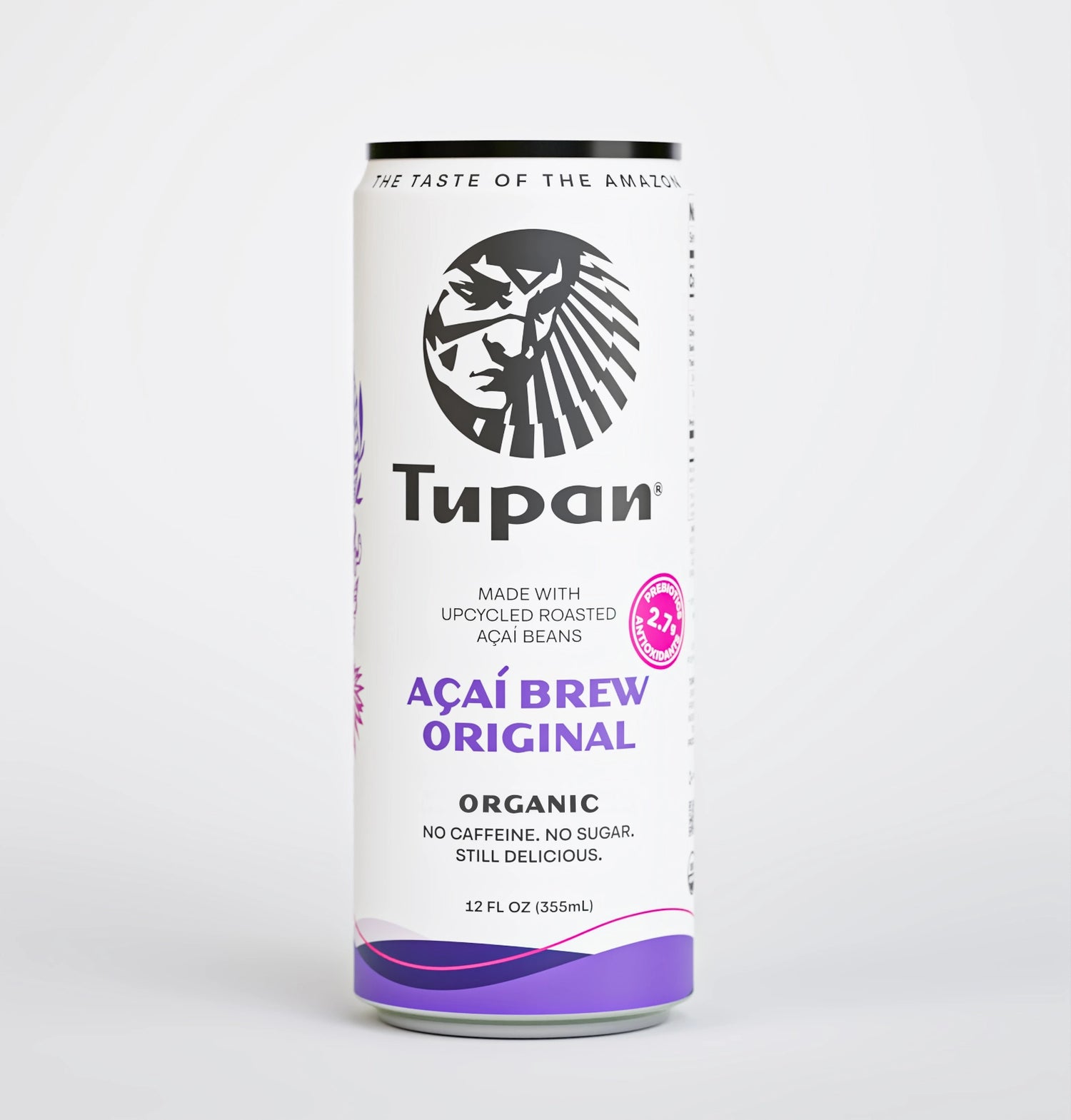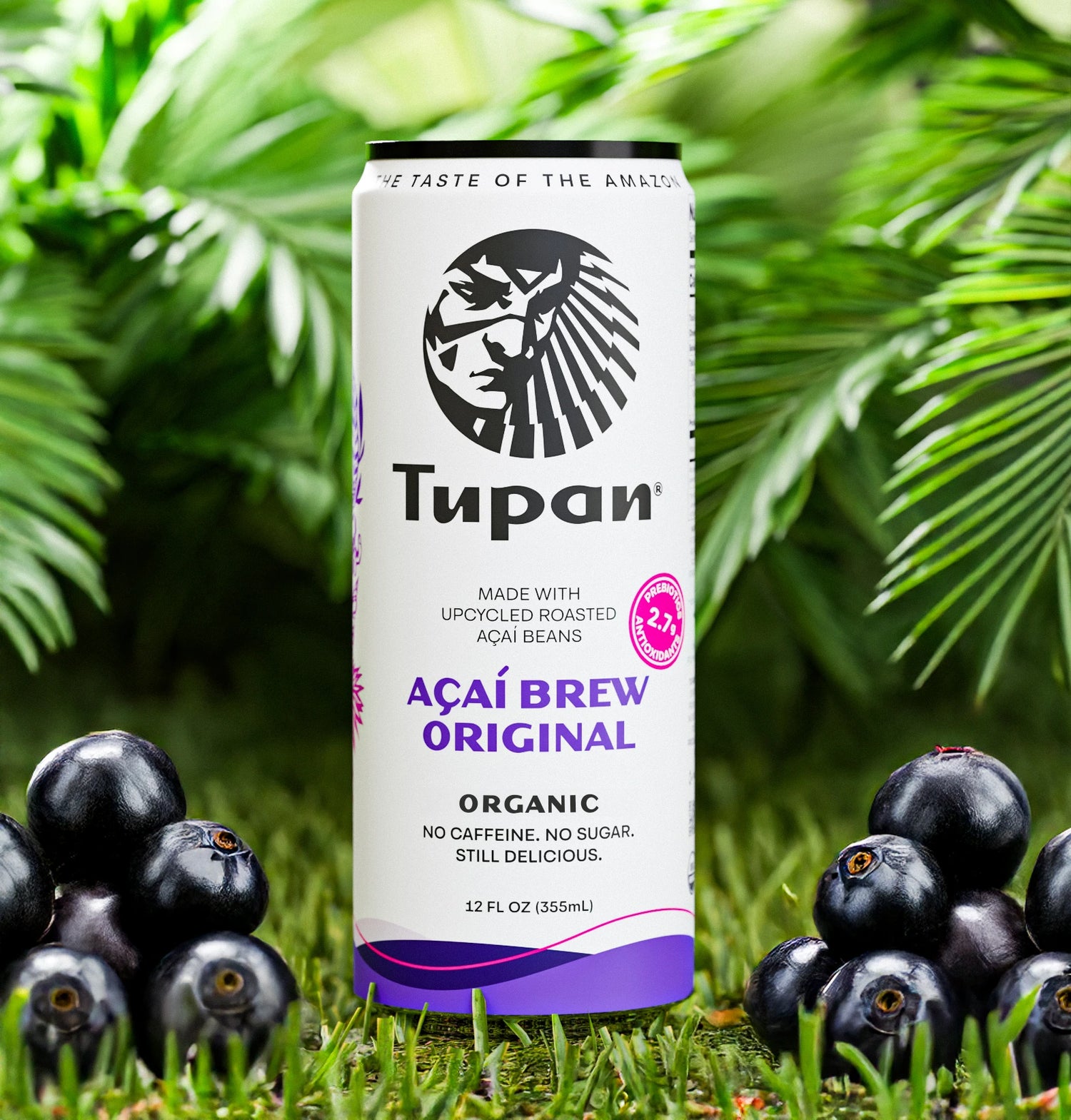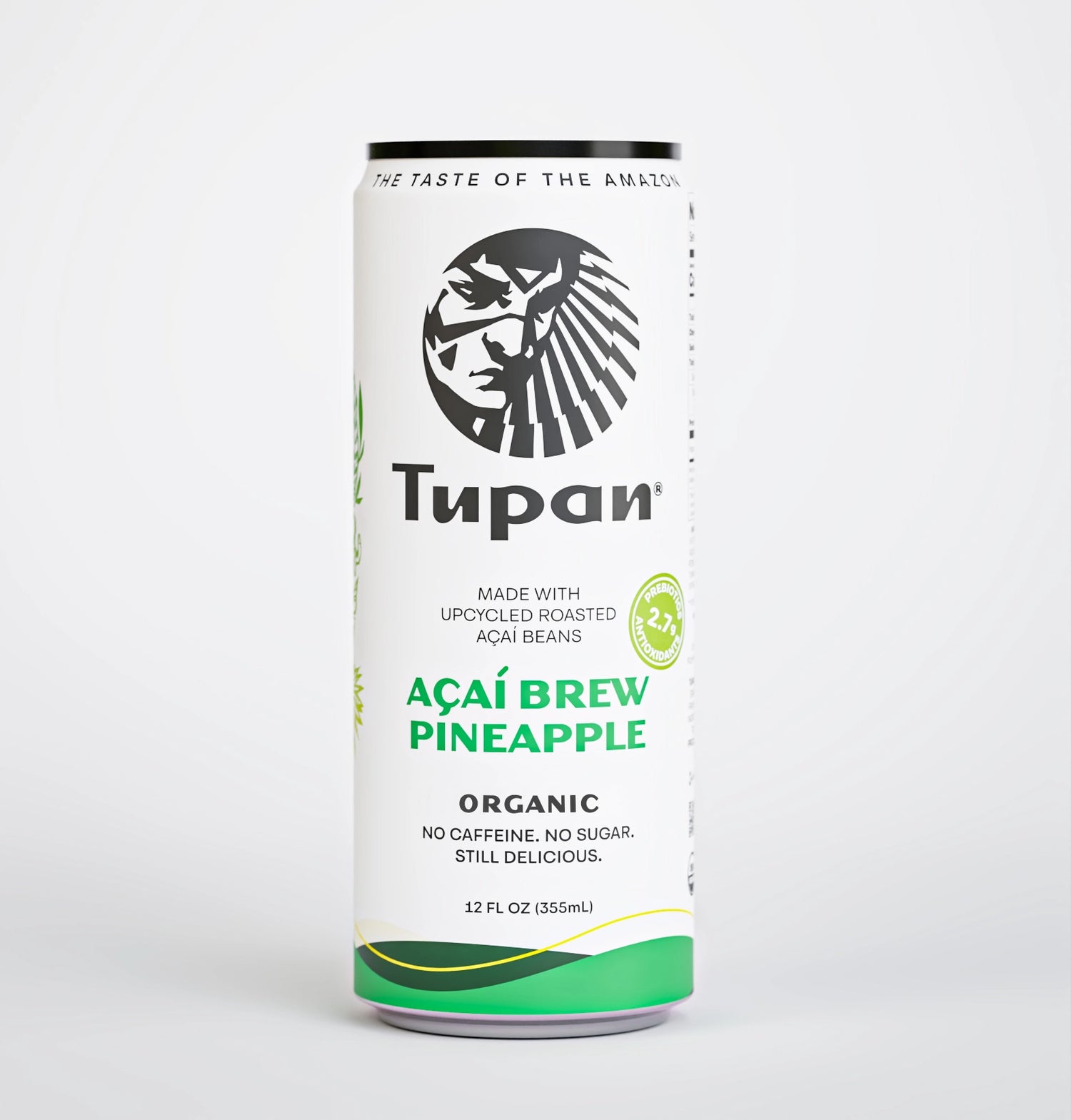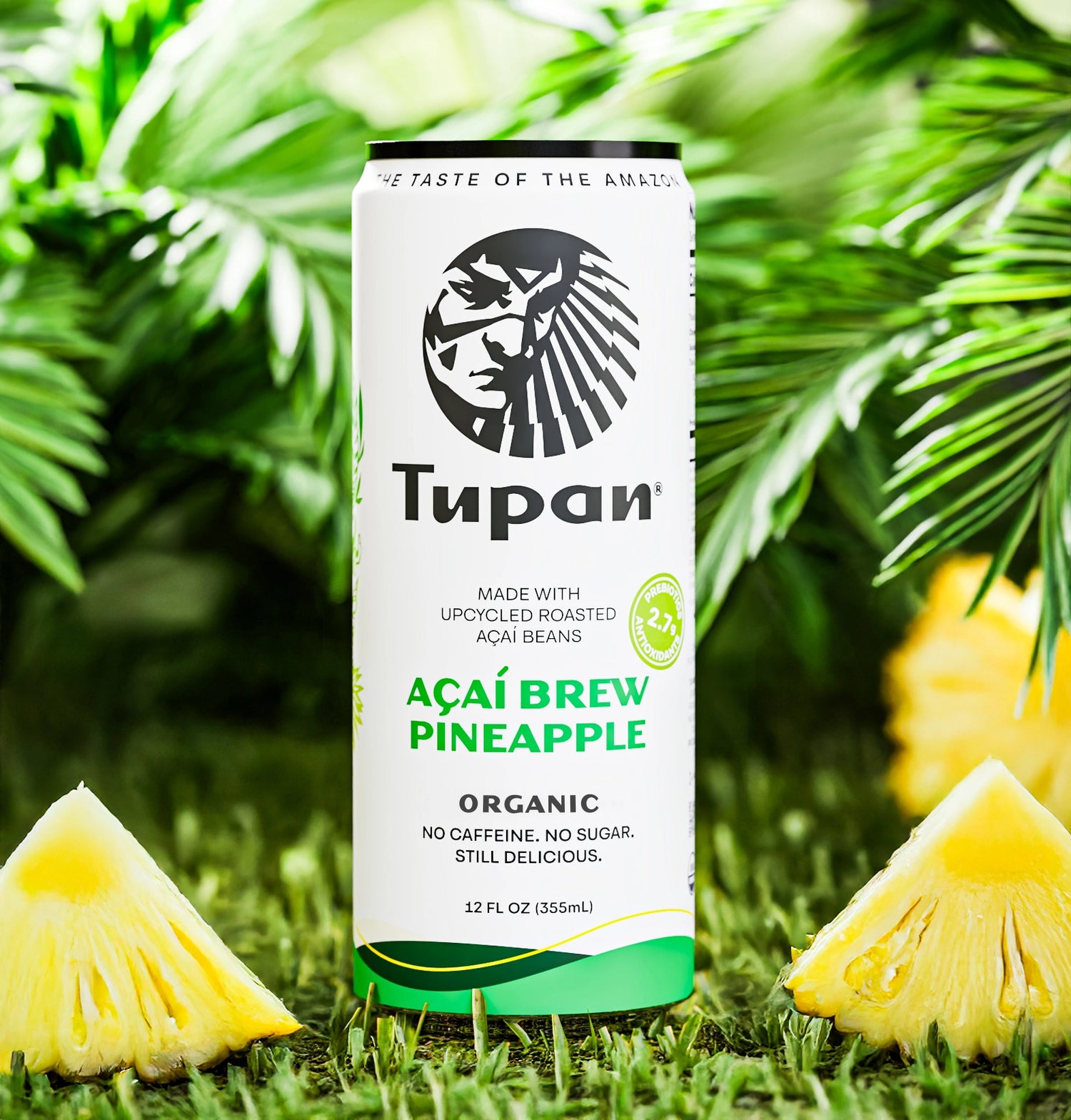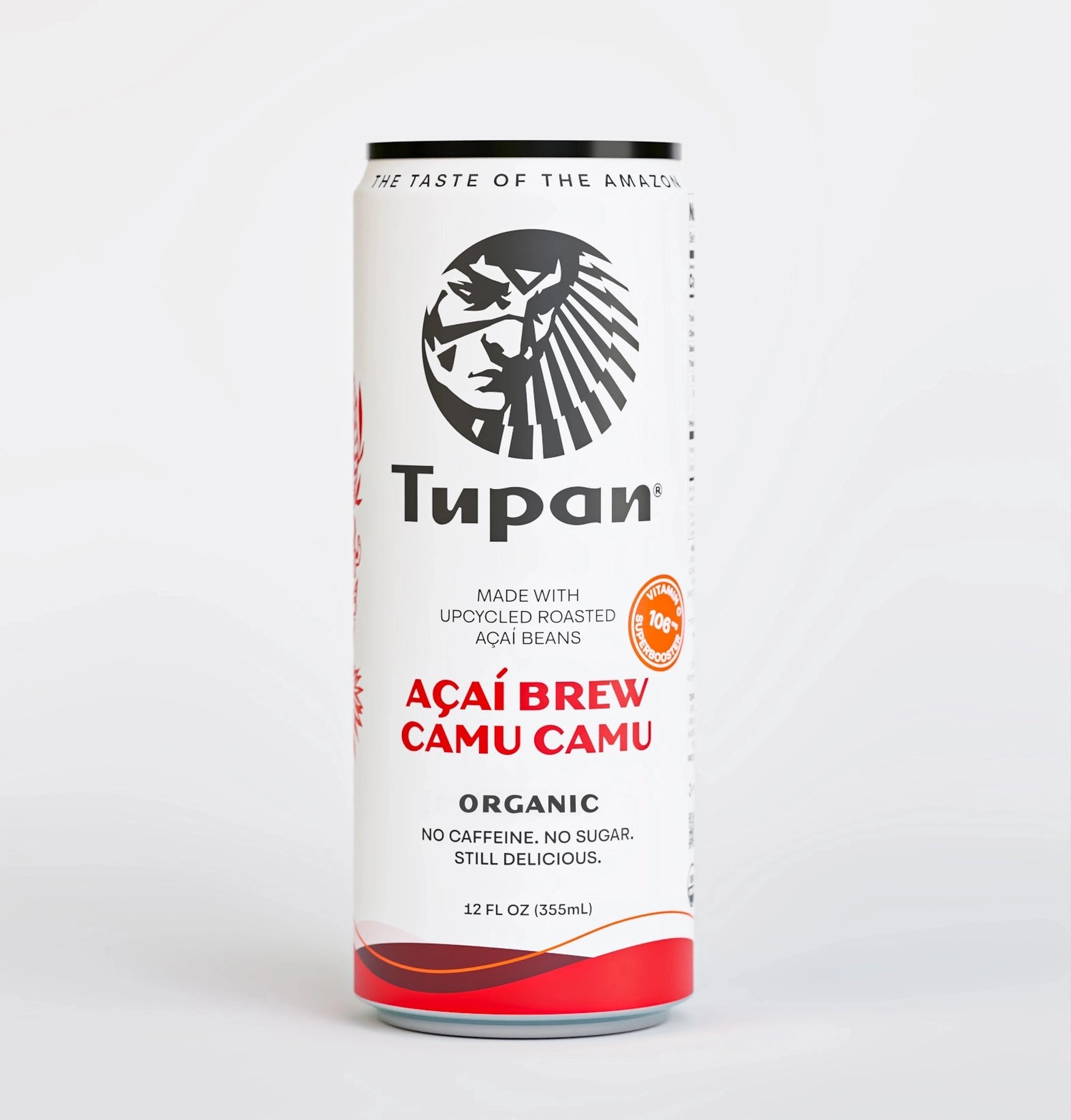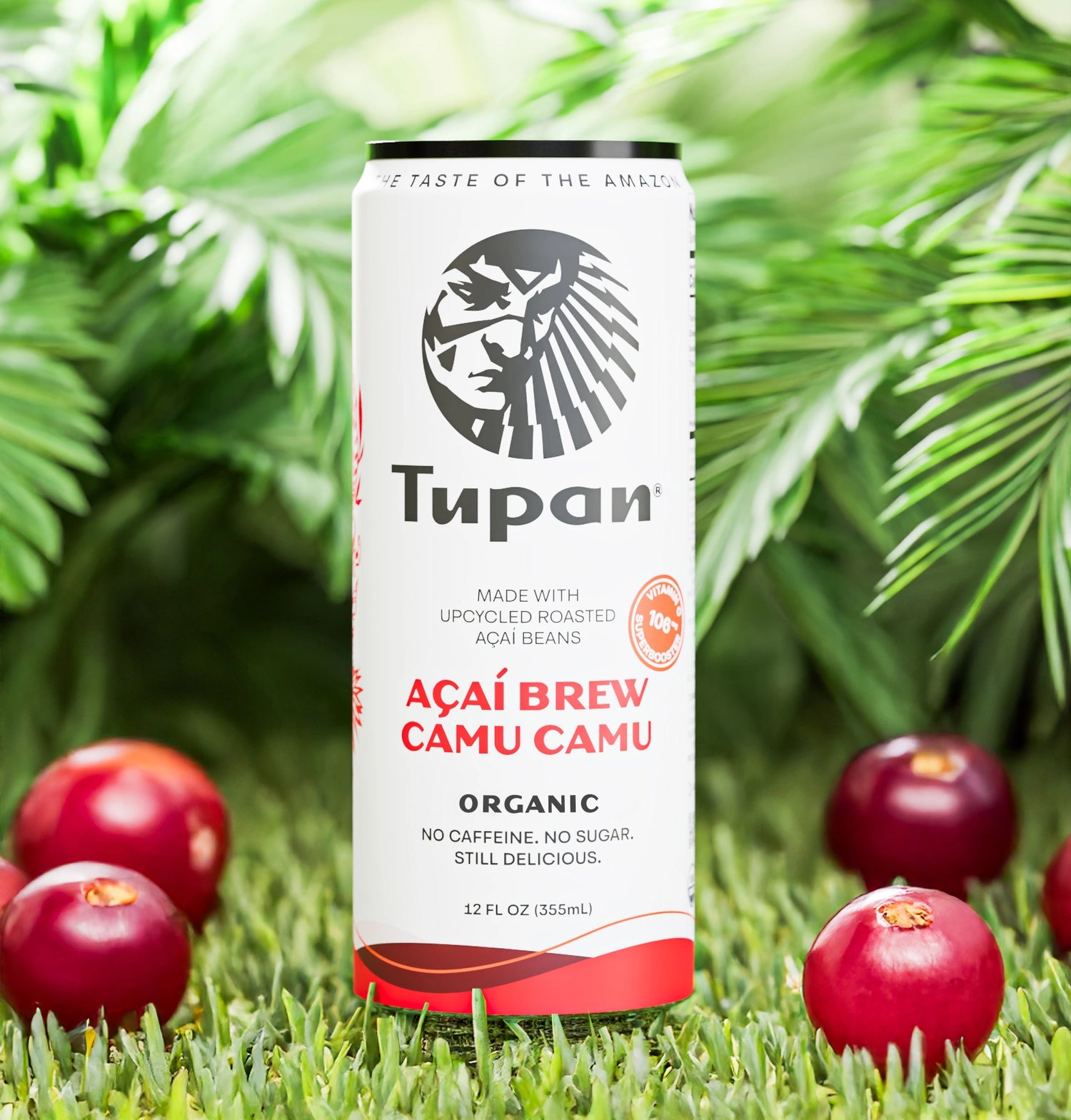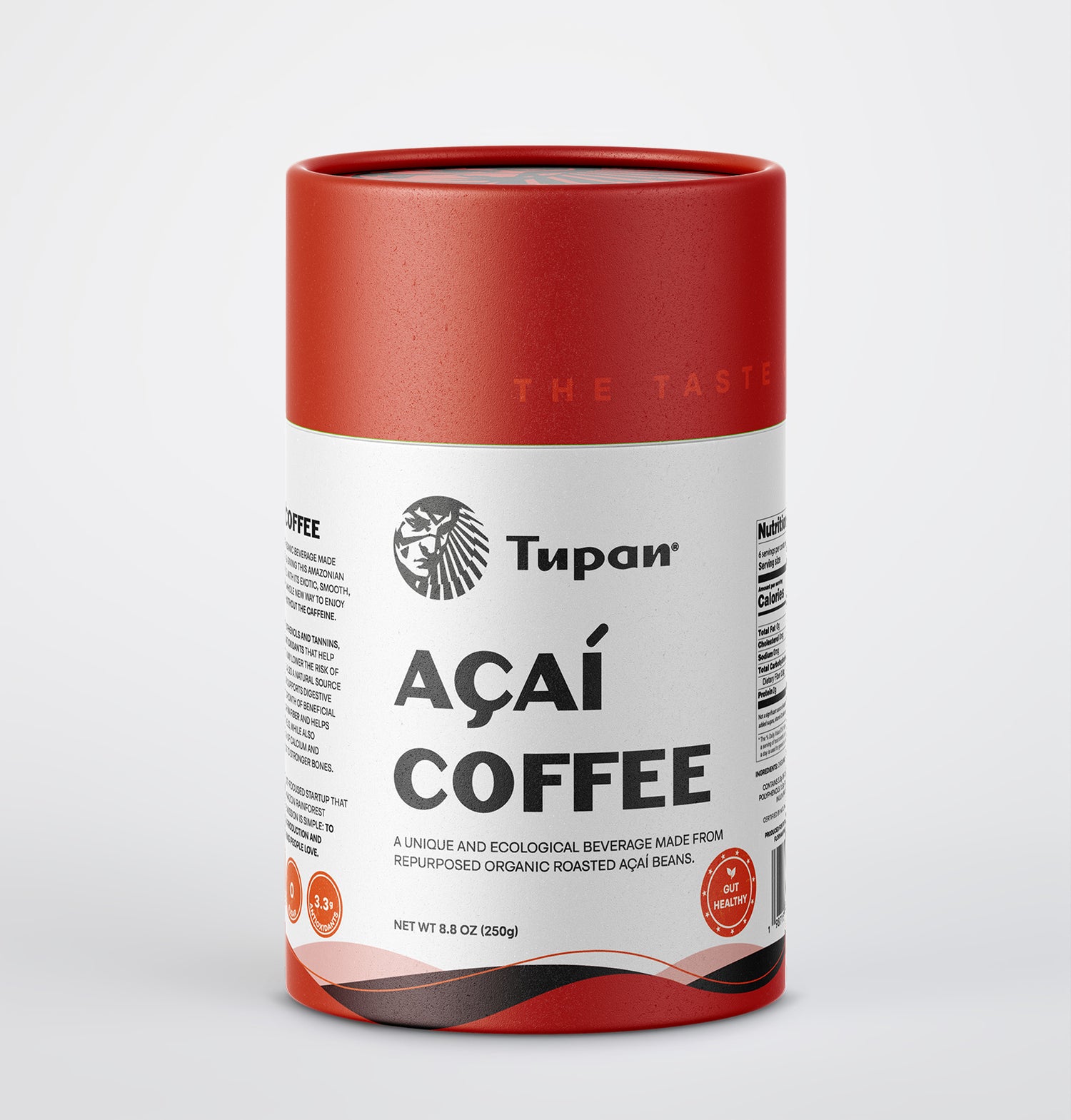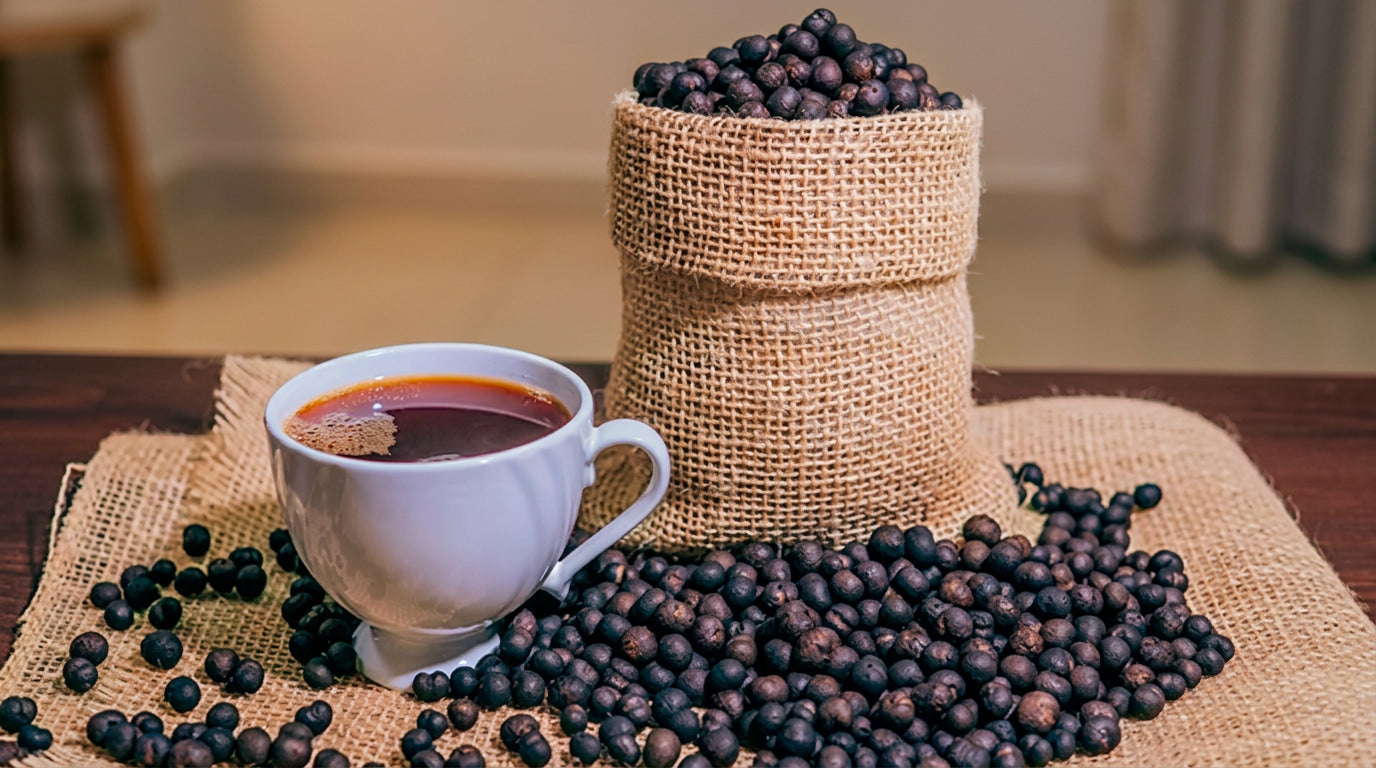
Açaí Coffee begins with a part of the açaí fruit that most consumers rarely see, yet it represents the vast majority of the fruit itself: the seed.
When people think of açaí, they usually picture the deep purple pulp used in bowls, smoothies and juices. But beneath that thin layer of pulp is a large seed that accounts for most of the fruit's physical structure. After the pulp is removed, those seeds remain in enormous quantities across the açaí-producing regions of the Brazilian Amazon.
Some of them can become something entirely different: Açaí Coffee.
The transformation is not as simple as taking an açaí seed and roasting it. Producing a consistent roasted beverage requires a sequence of decisions involving sourcing, selection, cleaning, drying, moisture control, roasting, cooling, grinding, storage and brewing.
Each stage can influence what eventually reaches the cup.
This is the journey from Amazonian açaí seed to Açaí Coffee.
IT STARTS WITH THE AÇAÍ FRUIT
Açaí comes primarily from palms of the species Euterpe oleracea, native to the Amazon region and deeply connected to the food culture and economy of Northern Brazil.
The fruit is small, dark purple when ripe and built very differently from the image many international consumers have of a "berry." Only a relatively thin external layer provides the pulp that is commercially extracted. The large central seed represents the dominant physical portion of the fruit.
That matters because the global popularity of açaí pulp creates a parallel stream of seeds after processing.
Historically, these seeds have often been treated as a low-value byproduct or residual material. Finding productive uses for them can create additional value from fruit that has already been harvested while reducing pressure associated with managing large volumes of residual biomass.
Açaí Coffee is one example of this approach.
For a broader explanation of the category, its origins, flavor, science and sustainability, explore The Ultimate Guide to Açaí Coffee.
STEP 1: THE PULP IS SEPARATED FROM THE SEED
The journey toward Açaí Coffee begins only after the açaí fruit has already entered the pulp supply chain.
Fresh açaí is processed to separate the edible outer material from the central seed. The pulp can then continue toward familiar products such as frozen açaí, beverages, bowls and food ingredients.
The seed follows another path.
This distinction is fundamental to understanding the circular-economy logic behind Açaí Coffee. The fruit does not need to be cultivated specifically for the roasted beverage. Instead, the process can create a higher-value application for material generated by an existing food industry.
But a seed leaving the pulping process is not yet ready to be roasted.
STEP 2: THE AÇAÍ SEEDS ARE SELECTED AND CLEANED
Raw material quality matters.
Seeds intended for food processing must be handled appropriately and prepared for the stages that follow. Depending on the production system, this can involve separation, cleaning and removal of unwanted material before drying and further processing.
This is where the idea that Açaí Coffee is simply "waste turned into coffee" becomes misleading.
Upcycling does not mean lowering quality standards. A secondary material stream only becomes a valuable food ingredient when it is managed through a controlled process designed for its intended use.
Traceability also becomes important. Knowing where the açaí originated, how the raw material was handled and how it moved through the supply chain helps create a more transparent connection between the Amazonian source and the finished beverage.
STEP 3: DRYING AND MOISTURE CONTROL PREPARE THE SEEDS FOR ROASTING
Before roasting, moisture must be managed.
Drying is a critical transition because water content influences storage stability, heat transfer and how the seed behaves during roasting. An ingredient entering a roaster with inconsistent moisture can respond inconsistently to heat.
That means two batches exposed to similar roasting conditions may not necessarily develop in exactly the same way if their starting conditions differ.
Controlled processing therefore begins well before the roast itself.
This is one of the reasons Açaí Coffee should be understood as a processed food ingredient with its own technical requirements rather than simply a roasted agricultural residue.
STEP 4: ROASTING TRANSFORMS THE AÇAÍ SEED
Roasting is the stage where the transformation becomes immediately recognizable.
Heat changes the seed's color, aroma, chemical composition and sensory profile. Recent scientific research has specifically investigated how roasting conditions affect açaí seed powder, including changes in phenolic compounds, inulin and volatile compounds associated with aroma.
A 2026 study published in the Journal of Food Biochemistry evaluated açaí seeds roasted under different combinations of temperature and time. The researchers found that roasting conditions influenced both bioactive retention and volatile development, demonstrating that the roast is not merely a cosmetic step. It is a major variable in defining the characteristics of the finished ingredient.
This is also where Açaí Coffee begins to develop the roasted sensory language that makes the category familiar to coffee drinkers.
Depending on the seed, processing conditions and roast profile, sensory characteristics may include toasted, nutty, earthy, woody, caramelized or cocoa-like notes.
There is no reason to expect every Açaí Coffee to taste identical. Just as roast decisions matter in conventional coffee, processing decisions can create meaningful differences between roasted açaí seed products.
ROASTING AÇAÍ SEEDS DOES NOT TURN THEM INTO COFFEE BEANS
This distinction is worth making clearly.
Botanically, the ingredient remains an açaí seed. It does not become a conventional coffee bean after roasting.
The expression "açaí bean" or "roasted açaí bean" is sometimes used commercially because it gives consumers an intuitive way to understand the ingredient in the context of a roasted beverage. But Açaí Coffee and conventional coffee come from entirely different plants.
Traditional coffee comes from seeds of plants in the Coffea genus. Açaí Coffee comes from the seed of the açaí palm.
What connects them is not botanical identity. It is the transformation and ritual: roasting, grinding, extracting and drinking.
STEP 5: THE ROASTED SEEDS ARE COOLED AND GROUND
Once the desired roast has been reached, the roasted material must be cooled and prepared for grinding.
Grinding increases the surface area available to water during brewing. Particle size therefore becomes another variable in extraction.
A very coarse grind and a very fine grind expose the roasted material differently to water. The appropriate particle size depends on the product design and intended preparation method.
The resulting ground material may visually resemble ground coffee, but its botanical origin and composition remain distinct.
Scientific literature now describes roasted açaí seed powder as an ingredient capable of producing an aqueous beverage or infusion with coffee-like characteristics. Research published in Foods in 2025 evaluated roasted açaí seed extract and found that preparation conditions such as water temperature influenced the extraction of phenolic compounds and antioxidant capacity.
In other words, what happens after grinding matters too.
STEP 6: THE GROUND AÇAÍ SEEDS ARE BREWED
This is where the transformation finally reaches the cup.
Hot water passes through or comes into contact with the ground roasted açaí seeds, extracting soluble and dispersible compounds into the beverage.
Brewing variables can include the amount of ground product, water volume, water temperature, contact time and filtration method. These factors can influence strength, aroma, body and the compounds extracted from the roasted material.
A 2025 study on commercial roasted açaí seed powder selected an extraction condition using boiling water and found measurable phenolic compounds, flavonoids and antioxidant capacity in the resulting beverage. Another 2025 study published in Molecular Nutrition & Food Research characterized beverages made from commercial roasted açaí seed samples from different regions of Brazil and investigated their antioxidant properties through simulated gastrointestinal digestion.
These studies are important because they examine Açaí Coffee as an actual brewed beverage—not merely the raw seed from which it originates.
For preparation instructions designed specifically for Tupan, visit Tupan Açaí Coffee.
WHY DOES AÇAÍ COFFEE TASTE ROASTED IF IT IS NOT COFFEE?
Because "roasted" is not a flavor that belongs exclusively to coffee.
Heating plant materials creates complex chemical reactions that can generate new aromatic and flavor compounds. The raw ingredient and the roasted ingredient can therefore smell and taste dramatically different.
This is why the sensory experience of Açaí Coffee should not be judged by asking whether an açaí seed naturally tastes like a cup of coffee.
The relevant question is what happens to that seed after controlled processing and roasting.
The result can be a dark, aromatic beverage with its own combination of roasted characteristics. It may occupy a familiar drinking occasion while maintaining a distinct identity.
If flavor is the question that brought you here, read our dedicated guide: What Does Açaí Coffee Taste Like? A Complete Flavor Guide.
IS AÇAÍ COFFEE NATURALLY CAFFEINE-FREE?
Pure Açaí Coffee made exclusively from roasted açaí seeds is positioned as naturally caffeine-free, and recent scientific studies of roasted açaí seed beverages describe the ingredient as a caffeine-free coffee alternative.
That does not mean every commercial product carrying the words "Açaí Coffee" must automatically be caffeine-free. A finished blend could contain conventional coffee, tea, added caffeine or other ingredients.
The ingredient list and product labeling should always be the final reference.
For a pure roasted açaí seed beverage, however, the absence of the conventional coffee plant creates a fundamentally different starting point from regular coffee.
WHAT HAPPENS TO THE FUNCTIONAL COMPOUNDS DURING PROCESSING?
This is one of the areas where emerging research is becoming particularly interesting.
Açaí seeds contain fiber and phenolic compounds, and scientific work has investigated components including inulin, tannins, flavonoids and other compounds associated with antioxidant activity.
Processing can change them.
The 2026 roasting study found that temperature and time affected the chemical and volatile profile of açaí seed powder. Research on brewed roasted açaí seeds has also shown that extraction conditions influence what moves from the ground ingredient into the beverage.
That distinction is essential when discussing nutrition responsibly.
The composition of a raw seed, a roasted powder and a prepared cup are not automatically identical. Raw-material origin, drying, roasting, grinding, brewing, formulation and serving size can all influence the finished product.
Consumers should therefore rely on product-specific Nutrition Facts and validated information rather than assuming that every Açaí Coffee provides the same quantities of functional compounds.
FROM BYPRODUCT TO A NEW BEVERAGE CATEGORY
The production process reveals why Açaí Coffee is more interesting than the phrase "coffee alternative" alone suggests.
It begins inside an established Amazonian food system.
The pulp already has a global market. The seed already exists as a consequence of that market. Processing technology creates an opportunity to give selected seeds another purpose.
That is upcycling in practical terms: taking a material that would otherwise have limited value and transforming it into an ingredient with a new use and a new market.
The environmental value should not be exaggerated. Açaí Coffee alone will not solve every waste challenge associated with the açaí industry. But it demonstrates a broader principle that matters to the future of food: agricultural side streams can be treated as potential resources rather than automatically as waste.
When that transformation is connected to quality control, traceability, responsible sourcing and market demand, circularity becomes more than a sustainability slogan.
It becomes a product.
HOW TUPAN CONNECTS THE AMAZON TO THE CUP
For Tupan, the process starts with a supply chain built around the Brazilian Amazon.
Our açaí seeds are connected to Amazonian sourcing through the Amazonbai cooperative and specialized processing expertise developed in Brazil. The objective is not simply to import an unusual ingredient into the United States. It is to preserve the connection between origin, people, processing and the finished beverage.
That connection matters because a new category needs more than novelty.
It needs a credible origin.
It needs repeatable quality.
It needs transparency.
And it needs a reason to exist beyond being different.
Açaí Coffee brings those ideas together in one cup: an Amazonian ingredient, a secondary material from an established food industry, specialized roasting and a new beverage ritual.
FROM SEED TO CUP, EVERY STEP MATTERS
The simplest description of Açaí Coffee is also accurate: it is a beverage made from processed, roasted and ground açaí seeds.
But the process behind that sentence is what gives the category its identity.
Açaí fruit is harvested. The pulp is separated. The remaining seeds are selected and prepared. They are cleaned and dried. Moisture is controlled. The seeds are roasted. The roasted material is cooled and ground. Hot water extracts the beverage.
What began as the largest physical part of a fruit famous for its pulp becomes something most consumers would never expect from açaí: a dark, aromatic roasted drink with its own flavor, science and ritual.
And that may be the most important part of the process.
Açaí Coffee is not about making an açaí seed pretend to be a coffee bean.
It is about discovering what the açaí seed can become on its own.
Want the complete story? Explore The Ultimate Guide to Açaí Coffee for a deeper look at the origin, flavor, brewing, science, sustainability and future of this emerging Amazonian beverage.
Source: Lima, R. C., Lelis, C. A., Andrade, J. C., & Conte-Junior, C. A. (2025). Investigating Roasted Açaí (Euterpe oleracea) Seed Powder as a Coffee Substitute: Effects of Water Temperature, Milk Addition, and In Vitro Digestion on Phenolic Content and Antioxidant Capacity. Foods, 14(15), 2696. https://doi.org/10.3390/foods14152696
da Silva, L. R., Feitosa, L. H. F., Silva, M. B. et al. (2025). Upcycled Beverage From Roasted Açaí (Euterpe oleracea) Seeds: Antioxidant Capacity and Cytoprotection Through Gastrointestinal Simulation. Molecular Nutrition & Food Research, 69(23), e70270. https://doi.org/10.1002/mnfr.70270
Pereira, G. S. L. et al. (2026). Roasting-Induced Changes in Bioactive Compounds and Volatile Profile of Açaí (Euterpe oleracea) Seeds Powder Assessed by Response Surface Methodology and Principal Components Analysis. Journal of Food Biochemistry. https://doi.org/10.1155/jfbc/6623391